Get Premium access to all the latest content online
Subscribe and view full print editions online... Subscribe

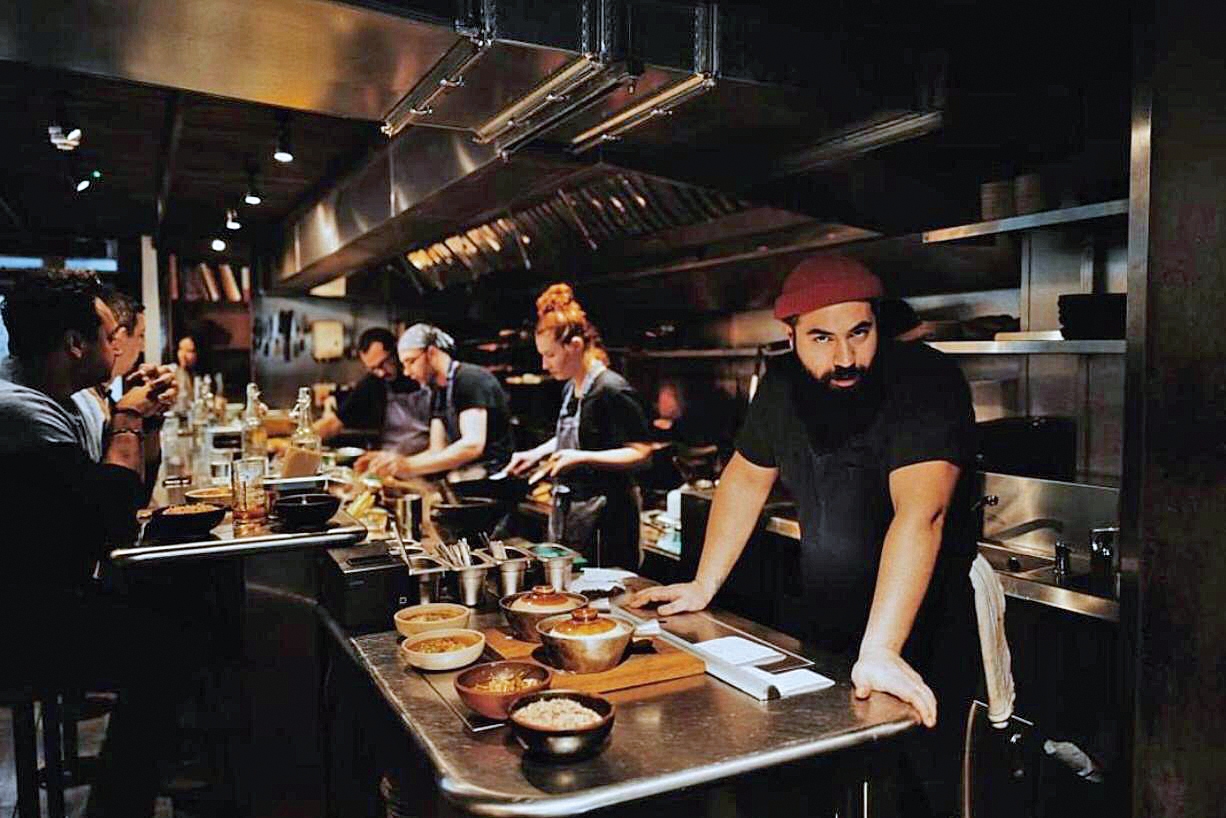
Born and raised in Tottenham, Meedu Saad, head chef and co-owner of Kiln, was surrounded by myriad influences but none were as strong as that his Egyptian father and childhood summers in Sinai
Words by Alex Mead
This article was taken from the February/March 2025 issue of Food and Travel. To subscribe today, click here.
Sitting atop Turnpike Lane tube station, on the doorstep of north London’s famous Green Lanes, the London Café was once a regular breakfast haunt for locals of a certain vintage. Perhaps its lesser-known claim to fame was as the first stop, some 20 years ago, on the culinary journey of Meedu Saad, the head chef behind the acclaimed Kiln. ‘A mate’s dad owned it,’ says Meedu. ‘I must have been 13, and he gave me a job, a couple of days after school, just washing plates. ‘It was a greasy spoon, but my friend was Turkish Cypriot, so they always had things like moussaka, they’d make their bread fresh and they were so particular about how they did everything. But they also did these huge breakfasts on oval plates – I’ll never forget them; I think I got PTSD from washing those massive plates...’
Influences were diverse, to say the least. Meedu’s mother was born in Chicago to an English mum and a Polish dad, and his Egyptian-born dad had a Lebanese mum. That his parents met and lived in Greece – Dad a sailor, Mum an au pair – added another cuisine to the pot. ‘My dad was the main cook in the household, so we had a lot of Egyptian food,’ he says. ‘He’s from Ismailia, right in Sinai – you’ve got the Mediterranean, Red Sea and the Suez Canal, so he’d pick a lot of fish. As you go into Egypt, people eat more meat and birds like duck and pigeon, but my dad was from a town dominated by seafood.’
Childhood summers were spent back in Egypt. ‘We’d stay at my grandmother’s flat near Ismailia and spend a lot of time in the Sinai Desert,’ he recalls. ‘We’d cross over the Suez Canal on a boat, then drive through the desert and go to Ras Sedr [on the coast], and just lift rocks and pick clams from the seabed with our toes. We’d fill up buckets and buckets of them and my aunt would boil them up. ‘We’d go fishing a lot too,’ he continues. ‘We’d swim out to this massive floating island made up of steel barrels with a cover, and sit and fish all day. It was a kind of madness, really, as there were all kinds of things in the sea, and you had to be careful – I got stung a few times by lionfish.’
But with an early passion fuelled by Ready, Steady, Cook on TV and making his own dinner when his parents worked, he was also taken by the food. ‘It’s got a lot of English and French influences,’ he says of Ismailia. ‘You’ll see it in the French-style villas and in the food. I remember when I was little sitting on the floor in my grandmother’s tiny little kitchen and piping petit fours, these really buttery biscuits, on to round pans.’ As he got older, he’d set off to Egypt ahead of his parents, taking in more of the country with relatives. ‘We travelled around a lot, but not enough considering how big Egypt is,’ he says. ‘We’d go to Alexandria, Port Said and Cairo. I hated Cairo as a kid because it was so busy, but now I think it’s a dream. It’s still pretty mental, though!’
Meedu’s most recent trip saw him not only take his four-year- old son for the first time, but also two of his restaurant managers. ‘I took them to the market in Ismailia where they have huge community ovens. You buy your fish and it all goes into earthenware pots with your vegetables, and the master cooks stick it in the oven.’ Even though it’s the largest Arab country in terms of population – 112 million – Meedu says to find the best food in Egypt you have to know where to look. ‘You have to dig deep for the best food scene,’ he says. ‘Even as someone who’s from there, I had to try to understand who was specialising in what in different towns; it’s not like going to Bangkok where everything’s just there.
‘There are cool places that just wouldn’t exist anywhere else
– places in between places,’ he continues. ‘It’s quite varied; you go to different towns and they’ll specialise in something different. Cairo has a great street-food scene – hawawshi sandwiches, roasted pigeons stuffed with rice, and loads of great grill places. There’s a place called El Gomhoureya, which means “the republic”, and they just grill lamb several ways and charge everything by the weight.
‘In north London, there’s lots of grilling too, but it’s very different in Egypt: they grill really close to the coals and they don’t add loads of spices and stuff. It’s about tasting the meat and the seasoning and the quality of grilling. ‘In Ismailia, one of the really famous dishes is grey mullet coated in wheat bran and baked in one of the community ovens,’ he adds. ‘Alexandria is seafood-based too, as is Port Said. You’ve also got all these giant ovens competing with each other. Then, if you go to Upper Egypt, Luxor and Aswan, it’s rural farmland with fresh cheeses and buffalo butter.’
There’s no shortage of culinary input from the wider region too. ‘We’ve had an influx of Arab food because of the Sinai Desert and the Bedouin. You’ll find stuff like kabsa (a rice, meat and spice dish), or where the whole animal is baked underground in the sand. There’s a huge variation because Egypt is full of different people. It’s big – we were there last year for five or six days and we did four cities, but it was exhausting.’
‘Grilling is very different in Egypt: they grill close to the coals and don’t add spices – it’s about tasting the meat and the quality of grilling’
Going beyond the cities is key to the Egypt experience. ‘The smaller towns are more interesting,’ he says. ‘I went to Faiyum, which is famous for pottery, and I visited a place called Nazla, in the west, which means “at the bottom” or “to go down”. They’ve been making pottery for thousands of years and passing on these techniques generation after generation. The pots are all porous so they’ve been used for fermentation for a long time. They have such a wealth of knowledge and there’s a lot of deliciousness, but it just doesn’t have any exposure.’
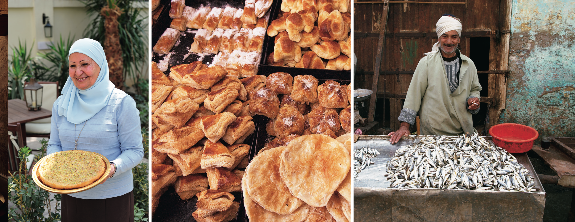
Naturally, over 5,000 years of history, the country has had lasting influences on the world, and celebrated dishes and cooking techniques are among them. ‘A lot of things came from Egypt,’ says Meedu. ‘You find things like bottarga, which Sardinia is famous for, came from the Egyptians; foie gras – the process of producing it – came from Egypt; I mean, bread, beer, the fork... I’m not trying to give a history lesson here, but it’s nice to know where things start! ‘Feteer meshaltet,’ he adds, to complete the lesson, ‘is a sort of laminated bread; it was the first of its kind, and a lot of people point towards it being the origin of the croissant. The Turkish took it first, and thenthe French took it and turned it into a crescent. ‘I think a lot of North African countries have techniques and flavours now heavily rooted in other cuisines they don’t really get the props for – but you can see it came from them.’
The chef’s role has taken him all over the world, including Thailand, which inspires much of his work, but there’s always a connection to his ancestral home. ‘The more you look, the more you’ll find connections in places you would never think of: the Persian influence on Thai food in the south, the huge Muslim community... I’ve made friends with people over there because food is one of the most powerful things for connecting people.
‘When you find similarity in cuisine, you don’t need to even speak the same language, you just sort of get it: we like the same thing; we’re the same. It’s simple really.’
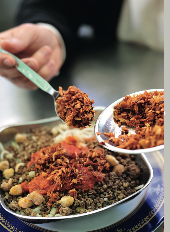
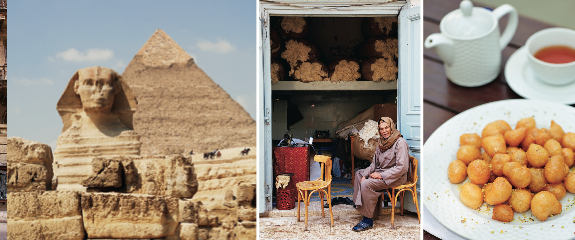
MEEDU SAAD’S CAIRO HOTSPOTS
EL GOMHOUREYA Amazing grill restaurant in downtown Cairo, serving lamb lots of different ways. 42 Al Falki
CAFÉ RICHE
An institution – a nice bar with small, fried dishes. You’ll catch live music if you’re lucky. 17 Talaat Harb St
EL KALAWY
This famous street cart is open until the early hours, selling fried liver and onion sandwiches in kaiser bread with pickles and chillies. Dokki, downtown Cairo
HAGOGA
Banquet-style Egyptian food with some of the biggest grills I’ve ever seen. I recommend the stews and rice dishes. Suez Road, hagogah.com
NAWAYA ORGANIC FARM An organic community farm serving up and teaching traditional recipes – some of the best food I ate on my last trip – get in touch before heading down. Abo El Nomros, nawayaegypt.org
FARAHAT GRILL
At the mouth of Khan el Khalili, the gold and spice market. Sitting in the alleyway eating pigeon, salad and buttered rice is memorable. 122 Al Azhar
EL HORREYA CAFÉ
One of the few places you can have a beer, and that’s all this place sells: local beer for local people. 2 El Mazloum St
Subscribe and view full print editions online... Subscribe