Get Premium access to all the latest content online
Subscribe and view full print editions online... Subscribe

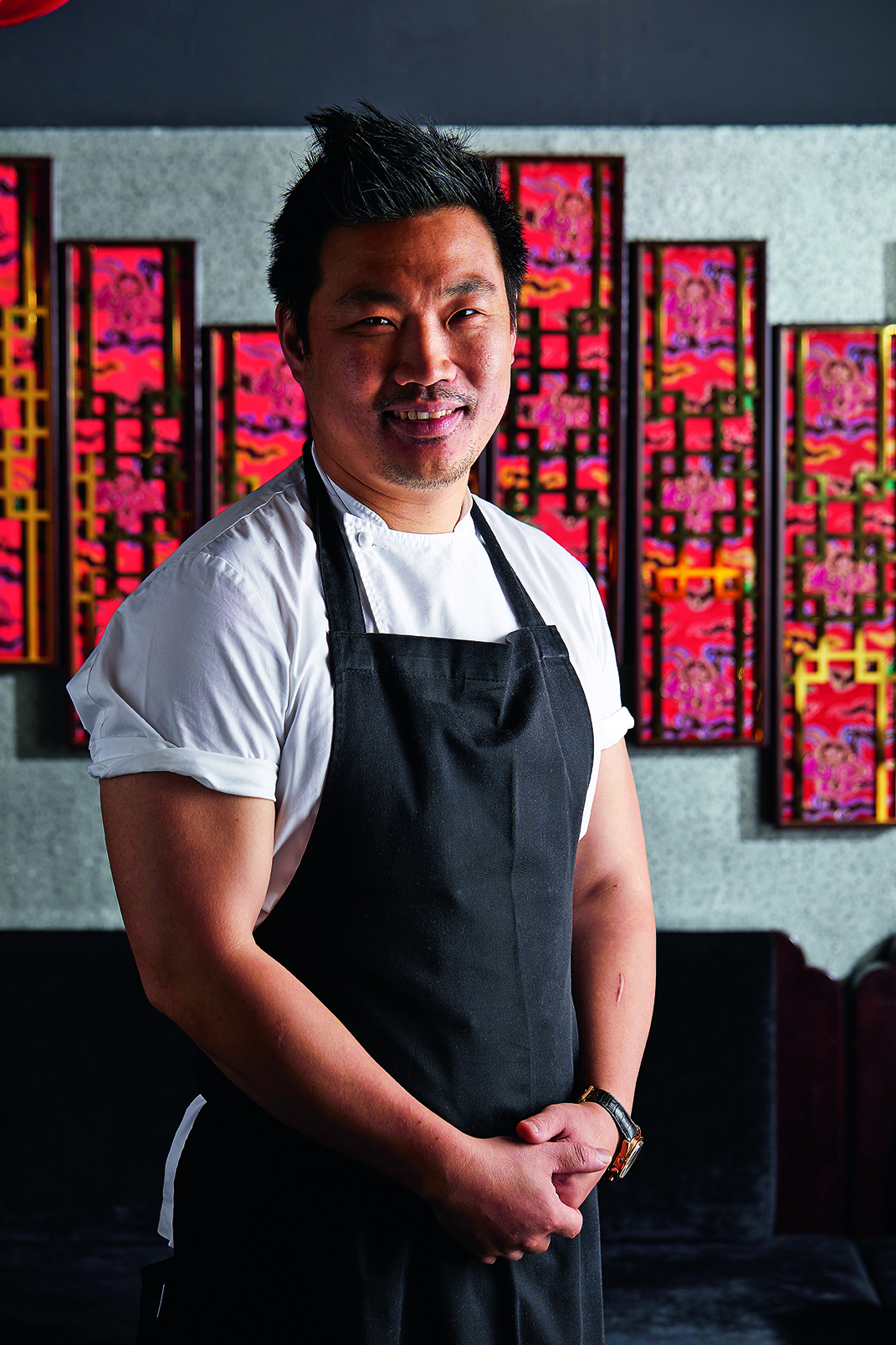
Born in 1982, Andrew Wong
spent his youth in his family’s
London restaurants. Swapping
the kitchen for academia, a
stint at Oxford University led
to a degree in anthropology
at the London School of
Economics, but the death of his father brought Wong
back to the stove. Part-time
work with the firm and evening
classes at catering college
followed, before a trip to China in 2003 saw him
working on Chengdu noodle stands, at Qingdao’s
Millennium Hotel and at the
Sichuan Institute of Culinary
Arts. On his 2012 return, he
reopened the family restaurant
under the name A.Wong. In
2017 it won a Michelin star.
A second venture, Kym’s,
launched six years later in the City. Wong is also a mentor
chef at Baoshuan at the Oberoi in New Delhi.
From the outside, it seemed inevitable that London-born Andrew Wong would end up in the food business. His grandfather owned a restaurant in Soho’s Chinatown; his dad ran pubs in the East End and Bristol, and his formative years were spent in the family eatery, Kym’s. Yet his gastronomic journey has been an epic one, even if the place that marks the past and present is one and the same. ‘The original Kym’s was here,’ Wong tells us as he makes a batch of har gow dumplings for his next service at A.Wong. ‘They opened in 1985, and I’d come home from school and the staff would babysit me while they worked. I’d eat there, too, simple dishes like steamed prawns with spicy garlic dips – delicious.’
In between, he was clocking up his first hours in the kitchen. ‘As soon as I was old enough to reach the sink, I was washing plates,’ he recalls. ‘I also had the job of closing up all those aluminium takeaway boxes. They were bloody sharp. I used to cut my fingers to shreds.’ Mixed feelings towards the business were coupled with teenage indifference to food. ‘I wasn’t bothered as a teenager,’ he says. ‘But I did know that steamed sea bass with rice was better than the shepherd’s pie I ate at school.’ Thanks, in part, to those finger-slicing containers, Wong put the hours in to pursue other career options. ‘I did a lot of extra maths homework to make sure I didn’t have to work in a restaurant,’ he says. ‘I studied chemistry at Oxford, then anthropology at the London School of Economics.’
At 22, his father passed away, and Wong’s direction changed. While at the LSE, he worked at the family restaurant and took a class in classical French cookery. ‘In Chinese kitchens, it always seems so disorganised, and I just wondered why French kitchens seemed so military-like, so well-drilled,’ he says. ‘I wanted to see if there was a way we could implement what they did in our kitchens.’
What he also discovered was that there was a science to cooking – something he could relate to. ‘It was like chemistry. If you add ‘A’ to ‘B’, put it on this heat, at this setting, then the outcome looks like that. I’d spent years studying chemistry at Oxford where you’d work in measurements of 0.0001g, so compared to that, your pastry recipe is easy. I understood the principles, so, beyond that, the rest of it was practise, practise, practise, until you got it right.’
The turning point came at catering college, when Wong, along with another student entered a Chinese cooking competition. ‘We made the menu up on the spot after a rummage through the college larder. I was inspired by my grandmother’s Sichuanese cooking, so we made pickled cucumber and sea bass poached in sesame oil – and we won,’ he explains. ‘I thought, “you know what, maybe I can do this”. You don’t have to spend 30 years in a Chinese kitchen to make something nice. Trust your own palate and you can make something delicious.’
Instead of taking a place at law school, Wong headed to China. ‘I’d wanted to go for a while, not just for work, but to learn Chinese,’ he says. As he travelled, he quickly discovered how unique each cuisine was. ‘I saw regionality for the first time,’ he explains. ‘There were differences not just in style, but in how ingredients were treated, like the use of fermented and dried food. Each chef had their own school of thought.’
The Sichuan Institute of
Culinary Arts was on his itinerary,
too. ‘I stayed with a friend who
was a teacher there and it was
amazing – it was semi-working,
semi-classes and I was learning
the principles of Sichuanese
cooking. And because of my
grandmother there were things I could relate to – like the use
of fermented chilli bean paste
and Sichuan peppercorns.’
He also learnt one skill that was quite unique to China. ‘We had to check if the eggs were fake,’ he says. ‘It’s the only place in the world where you get a fake egg – they fill it up with water to get a cheaper price. You have to check that the beef isn’t dyed pork, too.’
On a more practical basis, he experienced the sheer force of Chinese productivity. ‘I worked in a kitchen one morning and we had four weddings – that’s about 2,500 people. It was like standing in a railway station at rush hour, with all the trains zipping past you. Somehow all the food went out, though. ‘I think the biggest thing I learnt was that you don’t have to make everything yourself. At college we’d pride ourselves on making our ketchups or hams, but the Chinese laughed when I told them. They didn’t get it.
‘Now I understand. You have these talented people whose sole business and passion is to make one thing, such as fermented chilli bean paste or salted fish, so why make it and pretend it’s just as good?’
When Wong returned from China, the family restaurant was in need of change. ‘It was being run by other people and it wasn’t doing so well,’ he says. ‘It was out of date and the food was basically the Cantonese food that you’d get in the late Seventies. People didn’t want to try new things, they’d even know the numbers of their dishes. I wanted it to have a bit more life in it, a bit like a Chinese tapas bar, which was a concept that didn’t exist then.’
The ethos of regionality was going to be at the forefront, too. ‘Chinese restaurants celebrate one region and one region only, which is fine, because chefs come from one place and they’re proud of it, but China has 14 international borders and so much history. There’s something beautiful about this diversity, and I wanted to celebrate that across multiple dishes.’
He also wanted to pump up the atmosphere. ‘In places like Barrafina, the vibe is electric, just as it is in Barcelona. I wondered why we didn’t get that energy with Chinese restaurants?’
The original Kym’s was closed as Wong and his wife Nathalie set about overhauling the site. The money ran out early, so the decor was slightly compromised. ‘A journalist described it as “Scandi functional” and “Ikea-esque”,’ he remembers. But the food was good, winning plaudits across the capital. ‘We got great support from the press, we were lucky,’ he says.
In fairness, luck didn’t really come into it, as Wong’s modern Chinese earned a Michelin star in 2017. ‘We were still canteen- ish at that point, so we never thought we could do it – we never thought about it at all actually, especially as we were a Chinese restaurant.’
The plaudit changed
perceptions. ‘It’s a stamp
of authority,’ he says. ‘The
restaurant world is a fickle
one, though, because the day
before nobody cared about
what I thought, yet the day after the win, suddenly I’m an
authority on Chinese cooking,
which I’m not. I’m an authority
on our cooking, but I don’t
know everything about Chinese
food, that would be impossible.’
Last year, Wong, who named
A.Wong after his parents
Albert and Annie, brought
Kym’s back to life, albeit in
a very different form. With
120 seats, the all-dayer in
London’s Bloomberg Arcade is all about dishes to share,
with a focus on roasted meats.
‘The chef there is one of the very best in the country at roasting meats. He taught me how to do it, but you can only be as good as him with experience,’ he says. ‘He knows when the meat is right just by touch. You don’t get that unless you’ve roasted a lot of chickens.’
Post Kym’s, the future is sketchy. ‘There is no plan,’ Wong admits. ‘With restaurants it’s best to not make too many long-term plans, just do the best each day. If you forward think too much, then somebody is only going to come along and ruin it all. We’re just going to keep listening to our customers, evolving and improving – just as restaurants are meant to.’
Subscribe and view full print editions online... Subscribe