Get Premium access to all the latest content online
Subscribe and view full print editions online... Subscribe

Serves 6 Desserts and puddings



Cut two pieces of baking paper to fit two large baking trays. Put the paper on a clean worksurface and, using a plate as a guide, draw an 18cm circle in the centre of each piece with a black marker pen. Put the sheets on the baking trays, ink-side down.
Sift the ground almonds,icing sugar, cocoa and salt into a large bowl and set aside. If the ground almonds are very coarse, you could process all the ingredients in a food processor until the almonds arefinely ground, then tip into a large bowl.
Put the egg whites in the bowl of an electric mixer fitted withthe whisk attachment and beat on medium speed until whiteand foamy. With the machinerunning, drizzle in the caster sugar, 1tbsp at a time. When it has all been added, increase the speed to medium-high and continue to beat for around 2 minutes until the mixture is thick and glossy and holds stiff peaks when the whisk is raised.
Remove the bowl from the mixer and add about one-third of the sifted dry ingredients. Using a large, flexible spatula, fold the dry ingredients through the meringue to incorporate, making sure to scrape the bottom and sides of the bowl so that the mixture is evenly blended.
Scrape the mixture into the large bowl with the remaining dry ingredients and fold together with the spatula. Keep folding and turning the bowl until the mixture is thoroughly combined – this will take around 45 strokes with the spatula. Do not overmix, as this will break down the meringue and result in a thin batter, which won’t bake well. The batter is ready when it cascades (rather than ‘plops’) down from the spatula, in thick ribbons. Stop folding at this point.
Secure the baking paper on to the baking trays by dabbing a tiny bit of the macaron mix on the underside of each corner.
Divide the batter evenly between the two circles (approx. 230g each) and gently spread and level the mix with a small spatula until it covers the entire circle. Set the trays aside in a cool, dry place for around 45 minutes until the tops of the batter feel set and dry to the touch. Preheat the oven to 180C/160C F/Gas 4.
Put the macarons in the oven (one on the upper shelf andone on the lower shelf) and immediately lower the temperature to 160C/140C F/ Gas 3. Bake for around 25 minutes until the tops of the macarons feel crusty and firm.
Remove from the oven and transfer to a wire rack to cool completely.
When the macarons are cool and ready to be assembled, make the filling. Put the cream cheese or mascarpone and icing sugar in the bowl of an electric mixer fitted with the paddle attachment and blendon medium speed until smoothand creamy. Scrape the base and sides of the bowl with the spatula, then add the vanilla and cream and continue to beat on medium speed until soft waves form.
Carefully peel away thebaking paper from the macaron shells. Place one of the shells, flat-side up, on a cake plate,using a little of the Chantilly cream to secure it to the plate.
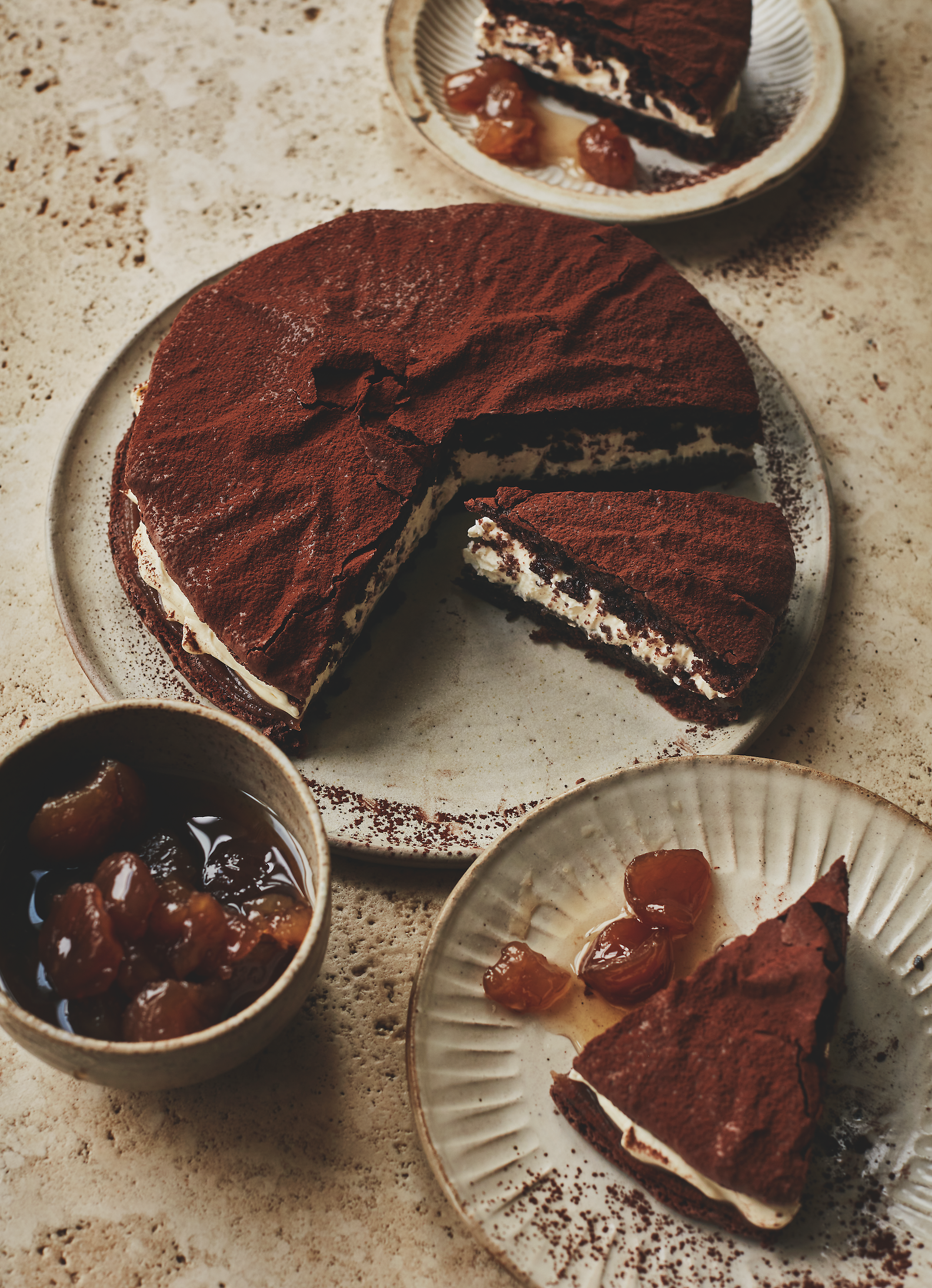
Spread the chestnut spreadover it, then dollop the Chantilly cream on top. Levelthe cream with a small spatula, then place the second macaron shell, flat-side down, on top of the cream.
Transfer to the fridge for at least 2 hours before serving, or keep wrapped in the fridge for up to 2 days.
Dust the top of the macaron with the extra cocoa powder. Plunge a knife into a jug filled with hot tap water for a few seconds, then dry with a clean tea towel before slicing.
Decorate with the marrons glacés and serve.
Advertisement
Subscribe and view full print editions online... Subscribe