Get Premium access to all the latest content online
Subscribe and view full print editions online... Subscribe

Serves 8 Desserts and puddings



For the pastry, put the flour and salt in a large bowl and stir with a dry whisk to combine. Have a bowl with 100ml ice-cold water ready. Put the cold butter between two large pieces of baking paper and bash with a rolling pin a few times until the butter is about 5mm thick. Tear the butter roughly into 3-4cm pieces and add them to the flour mix. Toss the butter pieces to coat in the flour, then rub the butter between your thumb and fingertips to form slightly thinner, smaller flakes. Don’t overdo this – the butter should remain irregular and visible.
Combine the cold water and lemon juice and start sprinkling this mixture over the flour and butter, mixing lightly until it comes together in a shaggy dough with the butter visible –you may not need all the water.
Wrap the dough loosely withcling film, then press gently to form a flattened disc. Transfer to the fridge for 30 minutes.
Lightly flour a clean worksurface and roll the pastry out, slowly shaping it into a rectangle approx. 40x20cm, trying to keep the edges straight and even as you roll.
The dough will still look quite rough at this stage, with flakes and streaks of butter visible.
Fold the top third of the pastry (the short end) down to the middle, then fold the bottom third up, like a business letter – this is the first ‘turn’.
Rotate the dough so that the seam is on your right, then roll it out once more into a 40x20cm rectangle and fold into thirds as before – this is the second ‘turn’.
Wrap the block and put back in the fridge for around 1 hour, then repeat the process of the two ‘turns’ once more. Transfer to the fridge for 1 hour or up to three days before using. When ready to bake, line a tray with baking paper. Roll the pastry out to a thickness of 3-4mm and, using a 25-28cm ovenproof frying pan (whichyou will use to cook the tarte) as a guide, cut a circle out of the pastry roughly 4cm larger all around than the pan. Transfer the pastry circle to the lined tray and transfer to the fridge. Stack the pastry offcuts, roll into a thick slab, wrap and chill or freeze for another use.
Wash, then peel the quinces using a vegetable peeler, taking care as they will be hard.
Quarter them if small or cut into sixths if large, then cut away the cores. You should have 950g–1kg quince. Set aside (it doesn’t matter that they will turn a little brown).
Preheat the oven to 180C/160C F/Gas 4. Arrange the sliced butter to cover the base of the frying pan in one layer. Rub the vanilla seeds into the caster sugar in a bowl, then sprinkle evenly all over the butter, covering it entirely.
Arrange the quinces on top of the vanilla sugar, packing them in quite tightly so there are no large gaps. Sprinkle the salt flakes and drizzle the lemonjuice all over, then put the pan over a medium heat to cook.
Allow the sugar to amalgamate with the butter for around 10 minutes – it will start to brown at the edges first, then begin to bubble and form a golden caramel all over. Do not stir, but gently swirl or shift the pan on the hob to promote even browning. Once the caramel is bubbling and golden brown all over, remove from the heat.
Remove the pastry circle from the fridge and drape it over the quinces. Working quite quickly, use a butter knife to tuck the edges of the pastry in so it forms a thin lip around the quinces when inverted. Put the pan on to the middle shelf of the oven and bake for around 1 hour until the pastry is puffed, golden brown and cooked through and the quinces are tender. Check by carefully lifting the pastry a little and inserting a skewer into the edge of the quince – it should go through with little resistance. Remove the pan from the oven and let it rest for 10 minutes to allow the caramel to set slightly – but not so much that it hardens.
Meanwhile, put all the ingredients for the Normandy cream in a large mixing bowl and whisk by hand for 1-2 minutes or until soft waves form. Keep in the fridge until ready to serve.
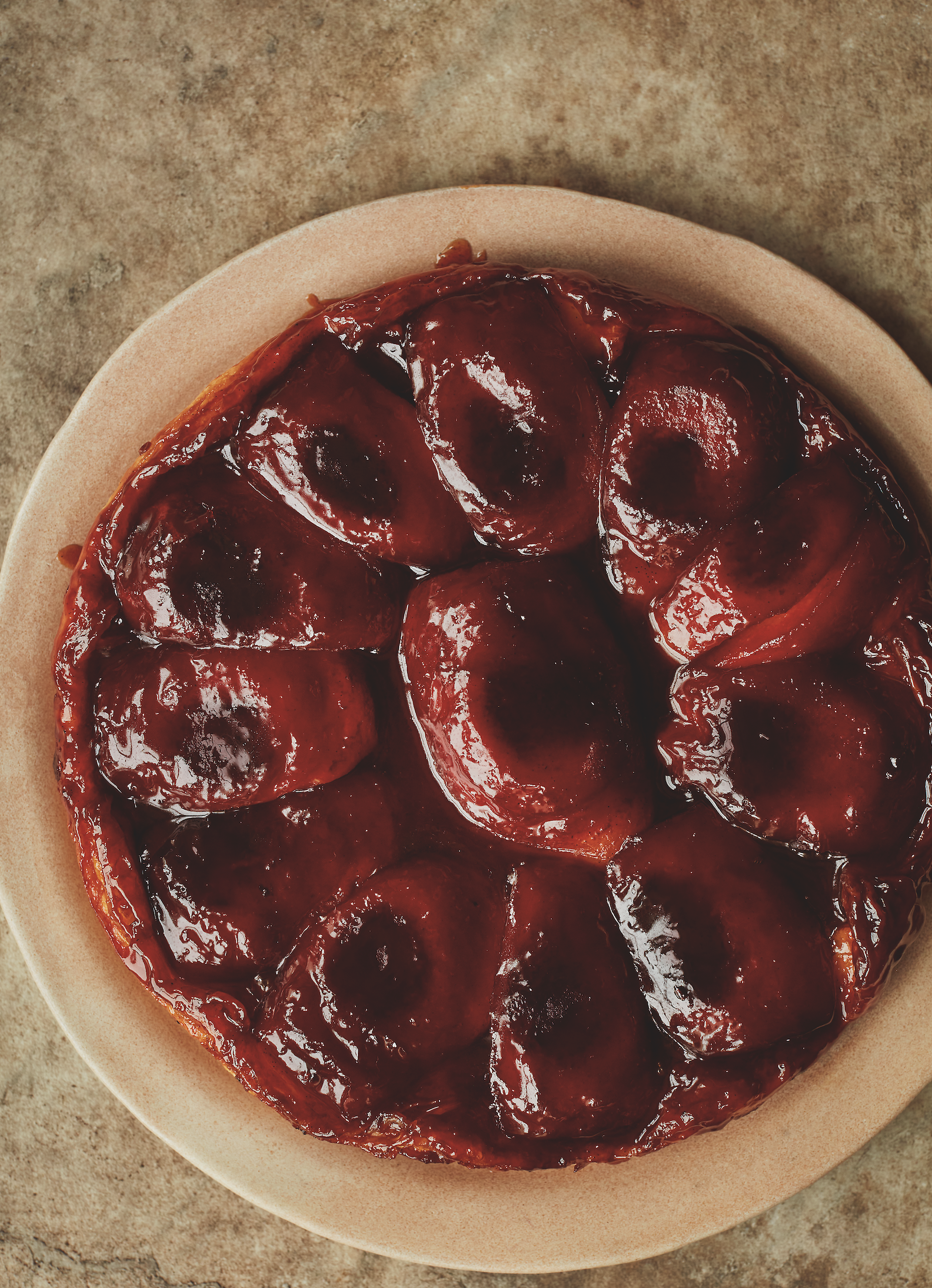
Set a serving plate (largerthan the frying pan and with arim to catch the caramel) overthe frying pan. Using oven mitts, quickly flip the pan and platetogether. Lift the pan away, and if any of the quinces have stuckto the pan, gently lift them outwith a spoon and put them backon to the tart. Spoon anyremaining caramel over andserve warm or at roomtemperature with the cream.
Advertisement
Subscribe and view full print editions online... Subscribe