
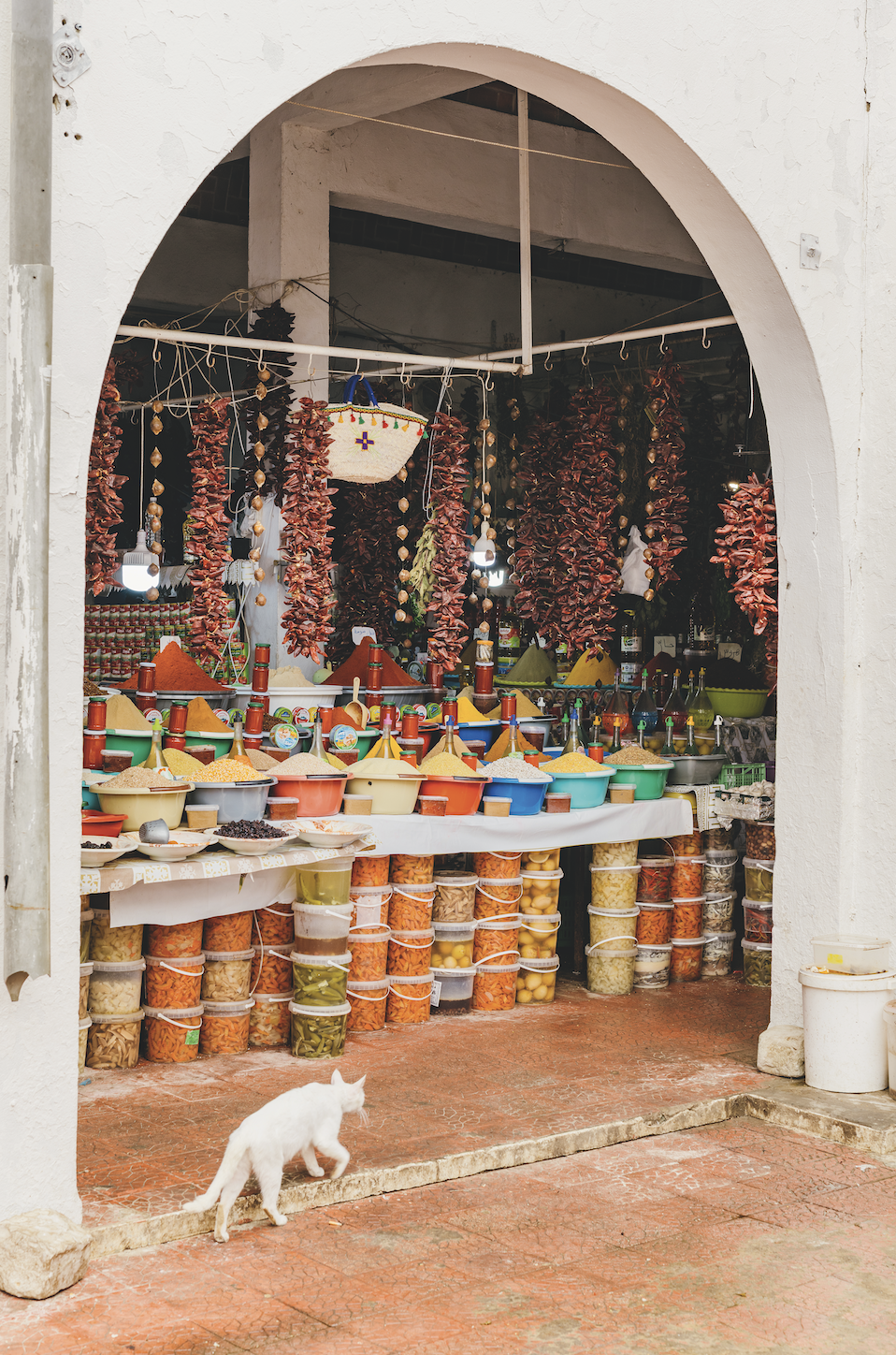
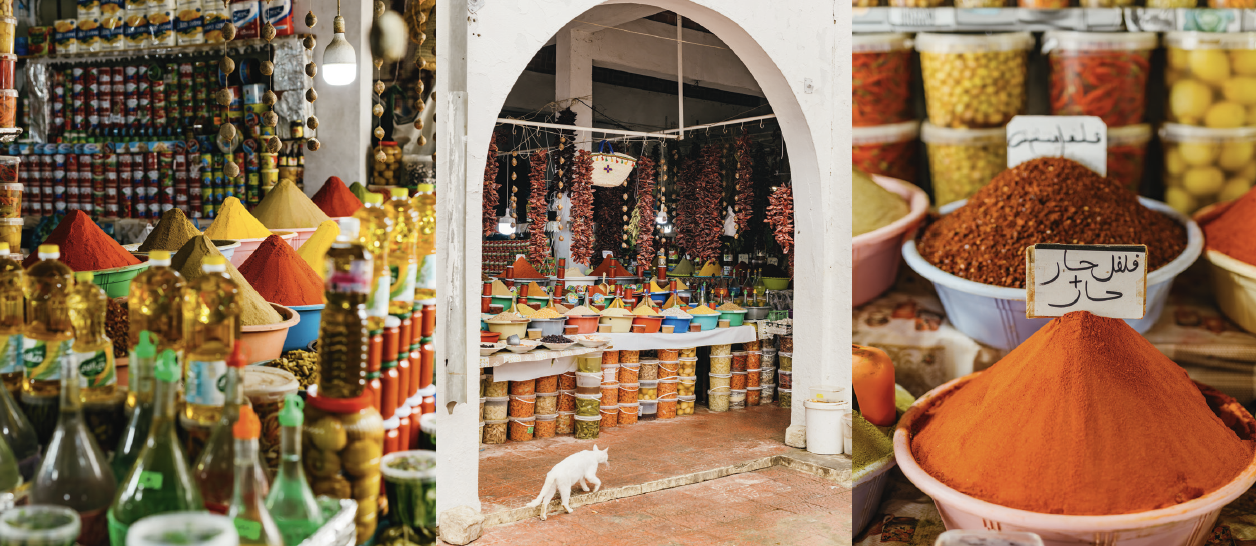
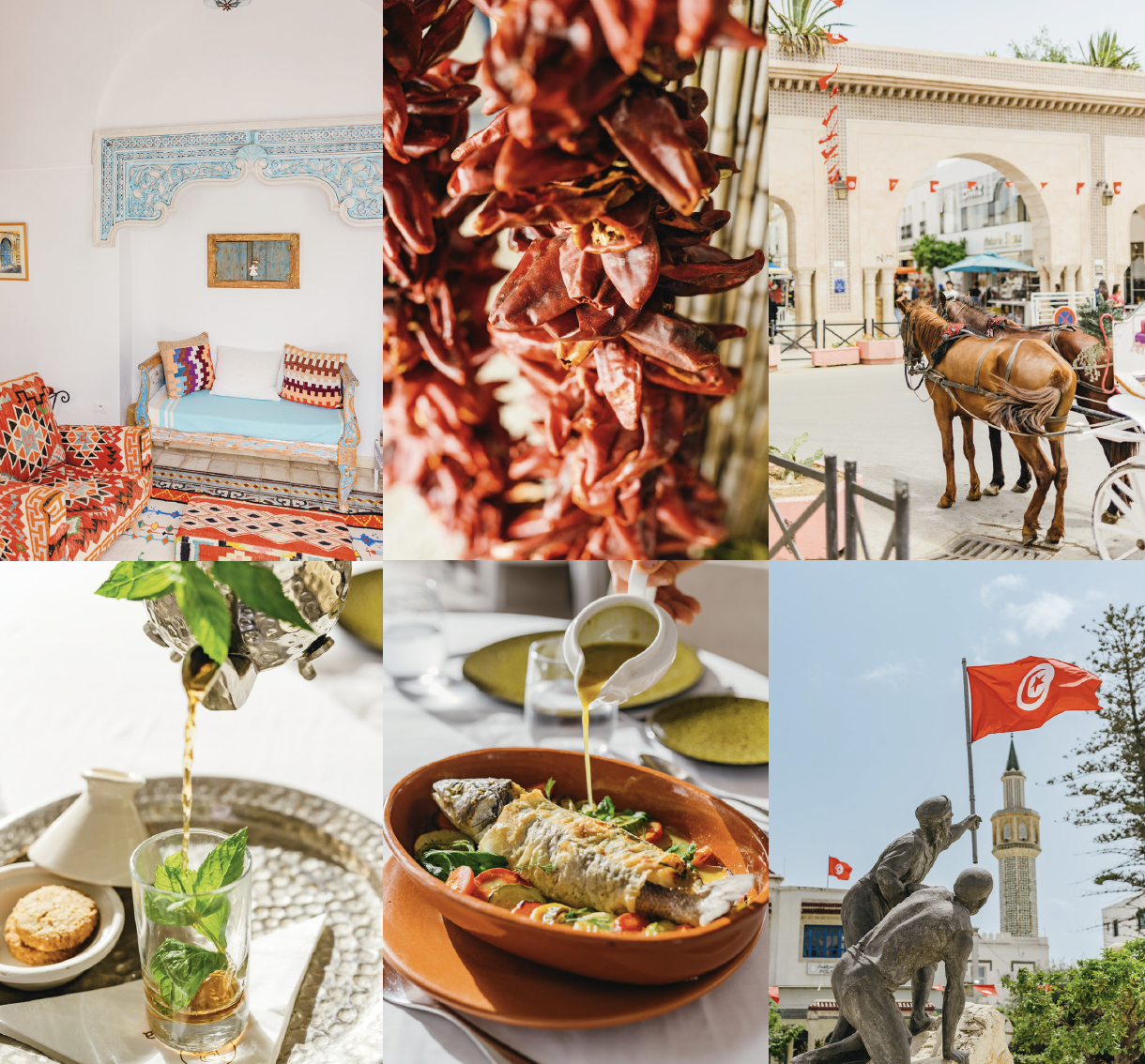
In the centre of Nabeul, a sun-baked coastal city on Tunisia’s Cap Bon peninsula, life is lived at full volume. A constant chorus of car horns, calls to prayer and spirited bargaining fills the air, as locals bustle through streets lined with market stalls. Step into the chaos and one detail emerges repeatedly: chillies. Strung in long, twisting garlands across windows and doorways, they dry in the sun like crimson bunting. Their fate? To become harissa, the fiery paste that underpins much of Tunisian cuisine.
Harissa has become a pantry staple for the UK’s more adventurous home cooks – a spicy, brick-red sauce of crushed chillies, garlic, salt, coriander and caraway. Its recent rise to fame is often credited to Yotam Ottolenghi, whose popular cookbooks helped introduce it to a broader audience. Yet few could pinpoint its origins. Ask around, and you’ll likely be met with blank stares or vague guesses. In fact, harissa was born right here in Nabeul, Tunisia, although several other North African nations also claim it as their own.
Just over an hour from the capital, Tunis, Cap Bon juts into the Mediterranean like a stubby little toe dipped in the sea. The cape is known for its golden beaches and hotel-lined stretches in nearby Hammamet, the quiet charm of Kelibia and the ancient ruins of Unesco-listed Kerkouane. But Nabeul stands apart: the cultural and commercial heart of Cap Bon, known for its vibrant markets, ceramics and traditional weaving.
In the city centre, ceramics studios showcase a craft shaped by centuries of influence: the potter’s wheel was commonly used by both Phoenicians and Romans; Islamic dynasties brought intricate decorative styles; and the indigenous Amazigh are credited with the earliest weaving techniques. Visit Rue des Nattiers in the R’Bat district to see artisans at work using methods passed down through generations. While Nabeul’s reputation rests largely on its craft heritage, its culinary significance is less widely recognised, although every Tunisian knows this is the birthplace of harissa.
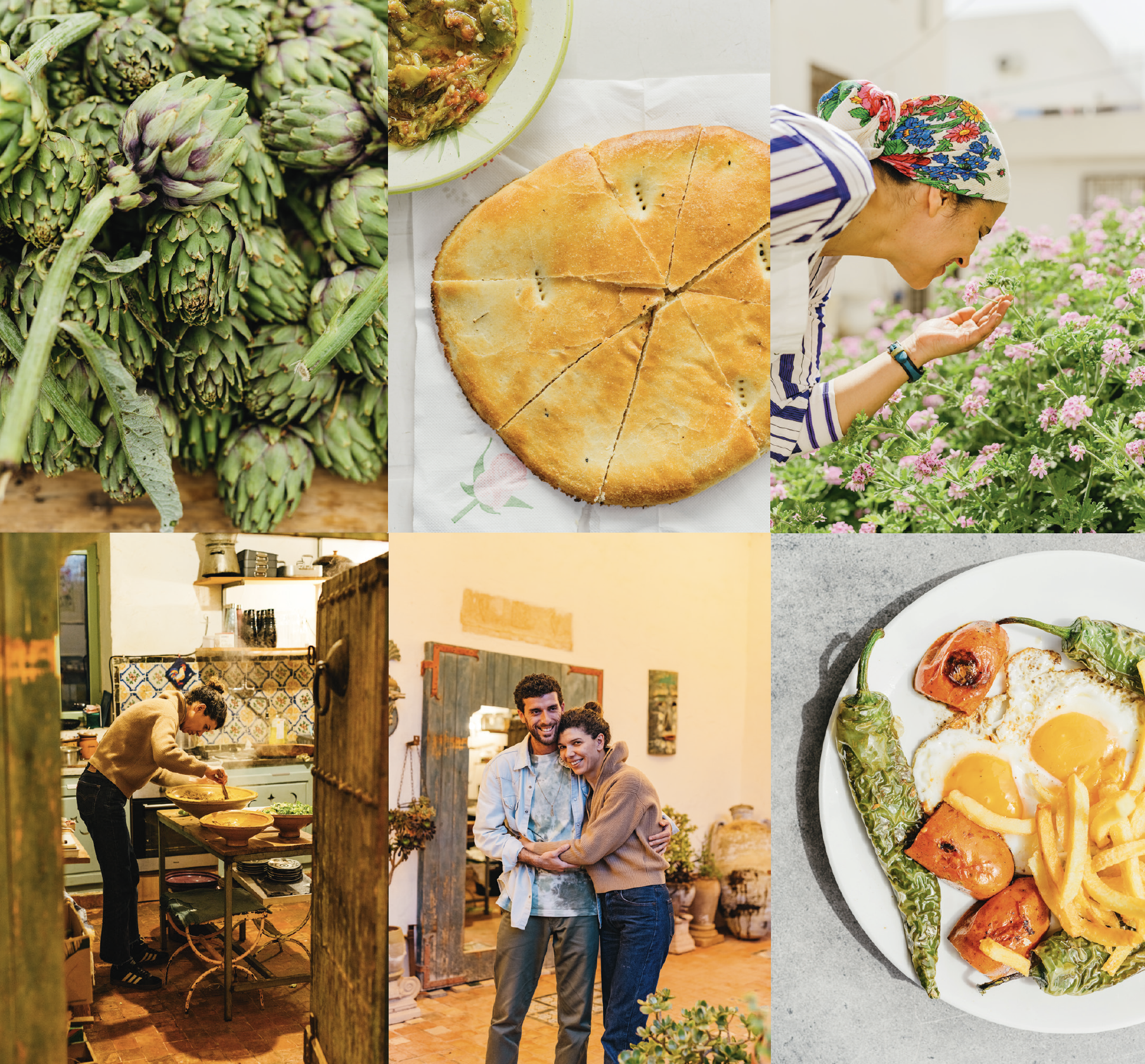
‘Harissa is part of our identity. Many of us grew up making it fresh every single day with our mothers or grandmothers,’ says historian and cook Imed Ben Attig. Imed and his wife Héla produce prize-winning artisanal harissa in Nabeul under the name Terroirs de Tunisie and, eager to champion their country’s cuisine, run harissa-making and cooking workshops too. During their classes you can expect to learn everything from the 66 registered types of chillies in Tunisia – six indigenous, such as meské, baklouti and shabeni – to how to make the shakshuka of the season (there are more than 60 varieties across the country). ‘We have so much culinary heritage but not enough governmental help to publicise it, nor specialised food journalists or historians to document it,’ laments Imed.
Little by little, though, that’s changing. Books, such as La Table du Nord (‘The Table of the North’, highlighting dishes from northern Tunisia) by presenter and journalist Malek Labidi are spreading the word. Initiatives like La Route Culinaire de Tunisie connect tourists with chefs, producers and artisans, making it easier for us to discover the country’s best wine, food products and dishes, as well as the locals making them. And in 2022, harissa was given Unesco heritage status. Proper harissa, that is. According to Imed, there are two types: industrial, which is prepared using fresh chillies and then preserved in a tin or tube, and the real stuff, made fresh each day during the season, using chillies that have been dried for days in the sun or in a special oven. To be pedantic, there is even a third type: a dried version in powder form – great as a meat rub or for adding a dry heat to dishes.
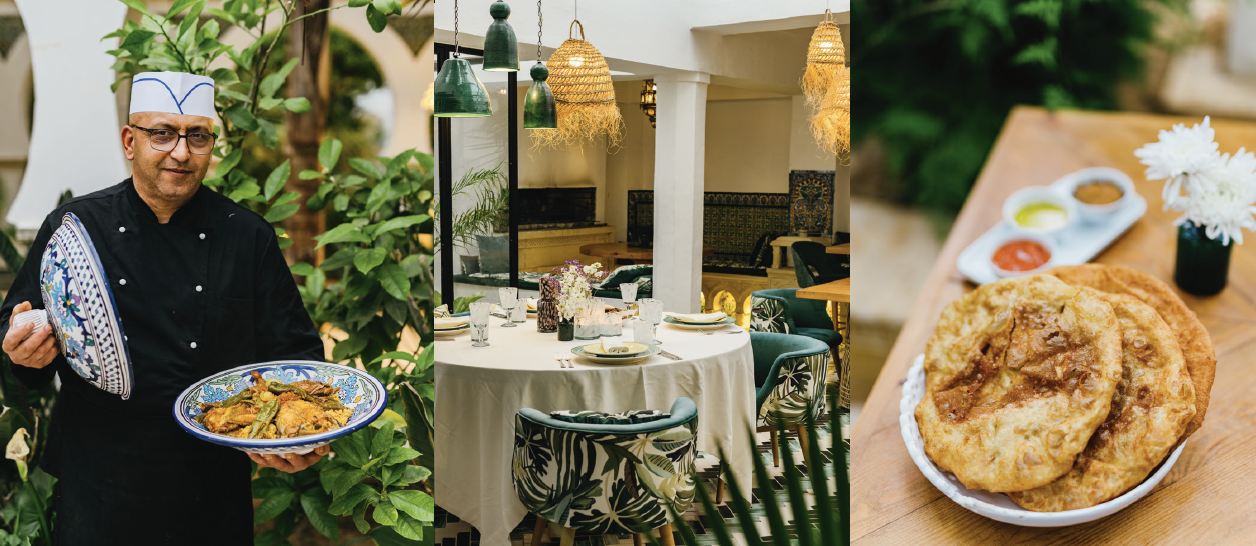
There’s no need for the visitor to seek out the genuine article when in Nabeul, though – it will come to you, unbidden, on plates drenched in olive oil, sneaked into stews and daubed on to bread.In fact, after just a day here, it becomes apparent that there are very few foods locals consider unimproved by its addition. And they’dbe right. At traditional Nabeulian restaurant Bon Kif, for example, a simple tuna brik (stuffed pastry) is transformed by the warm smokiness of this vibrant sauce, coating the inside of the delicate pastry.
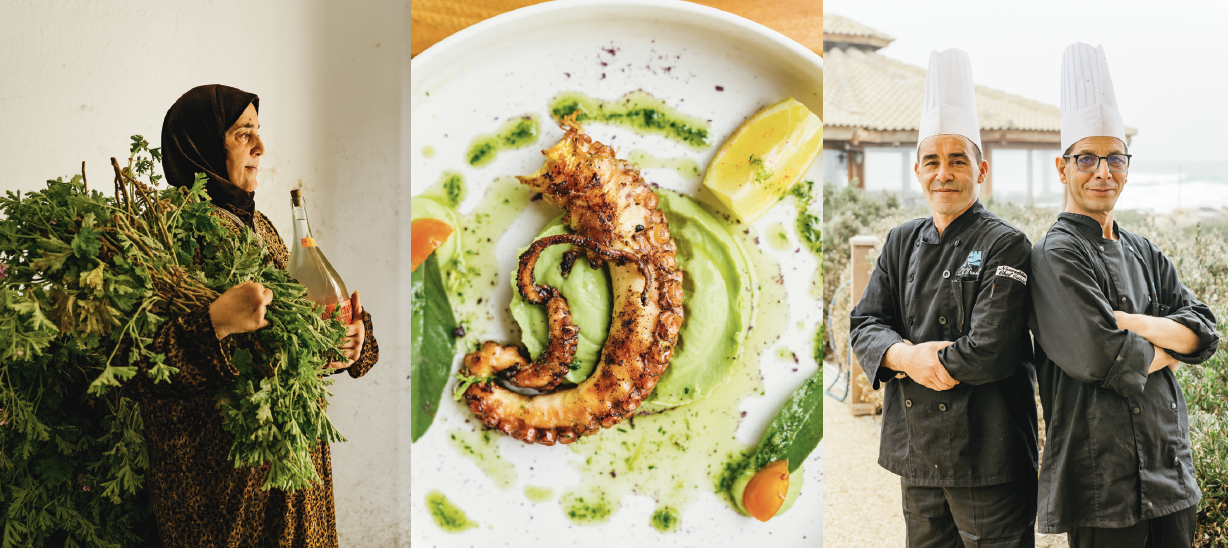
Remarkably, harissa is not the only iconic foodstuff that Nabeul is known for. The north-eastern city is also credited as the Capital of Floral Water, thanks to its long history of distilling aromatic plants – most famously orange blossom – into fragrant waters to be used for cosmetic, medicinal and culinary purposes. Added to tea, coffee, jams, pastries and couscous, these waters percolated through the rest of the country over several centuries until they became another Tunisian staple. The process is simple but long. Come spring, orange blossoms, followed by roses and geraniums, are hand-picked and, while still fresh, placed in a copper still with water. This is then slowly heated over open flames, producing steam, which flows through a cooling pipe, then condenses and collects as floral water in a separate pot. It can take at least one hour 30 minutes to distil enough to fill just one fuchka, a curved glass bottle with a narrow neck.
‘My memories of holidays as a child are of carrying out this process at my grandmother’s, along with my cousins – all girls. We all learned from her and would help every year. The ritual is not just about production; it is about togetherness,’ says Rania Mansour, as she compresses a large bunch of geraniums into her still. Today, Rania makes her living distilling and selling floral water and infused floral jams or spreads, as well as giving workshops. This isn’t a show put on for tourists, but rather a cherished family tradition that is still very much alive. ‘There are over 3,000 families in Nabeul who uphold the tradition at home, plus seven more industrial groups who have scaled the practice,’ she says. The city is one of the few major suppliers of floral water to the rest of the country.
So what is it about Nabeul and the broader Cap Bon peninsula that means this area is responsible for such integral facets of the Tunisian diet? Part of it is down to the fertile terroir and resulting produce. As you drive inland from Nabeul, the landscape changes from busy city streets lined with squat buildings to bucolic countryside: verdant fields, abundant with fruit trees, crops and vines. About half an hour from the eastern coast, near the village of Turki, La Ferme Agricole Tuniso-Suisse is a microcosm for the richness of rural Cap Bon. Depending on the season, filling its 15 hectares of fields will be rows and rows of anything from courgettes, chillies, carrots, tomatoes, oranges and lemons to melons, pomegranates, apricots and bergamot, the majority of which are farmed organically without pesticides.
‘Everything grows here,’ says Mohammed Abdelaziz Sadfi, a former banker-turned-smallholder who started this farm (complete with shop and restaurant) some 22 years ago with literal seed money from Swiss investment. ‘There’s a reason why they called it Cap Bon – here you have enough water, rich soil, and it’s sunny but the temperature is always acceptable. The peninsula has a mild microclimate thanks to its proximity to both sea and low mountains. This triumphant trinity, in fact, earned it the nickname ‘the pantry of the Mediterranean’. ‘A good example is those cypress trees over there,’ explains Mohammed, gesturing towards a cluster of conical trees in the distance. ‘We planted 1,000 and 998 grew. That’s just two that didn’t make it – miraculous.’
Cap Bon’s fecundity means it’s also one of the country’s most important wine regions. Viticulture here dates back to Carthaginian and Roman times, but it was during French colonial rule between 1881 and 1956 that the peninsula became a key area for grape growing and its wine production was modernised. Winemakers such as Domaine Neferis and Les Vignerons de Carthage have since continued to produce the likes of Selian Réserve, a rich and plummy oak-aged red wine made from old-vine carignan, and Muscat de Kelibia, a dry and fragrant white wine made from muscat of Alexandria grapes, for the domestic market.
Then there’s the fact that Cap Bon’s geographic closeness to Sicily has facilitated both trade and migration between the two countries and beyond since antiquity, thus shaping the region’s history and, in turn, cuisine. It was the Spanish who brought chillies to Tunisia in the 16th century, after Christopher Columbus returned from the New World with them. And migrants who came to Cap Bon from Spain and Sicily in the late 15th and early 16th centuries – Jews and Muslims facing religious persecution – and the Moriscos who followed are credited with the development of harissa. These same refugees also brought and refined the practice of floral water distillation in Tunisia.
All of which reinforces the notion of Tunisian cuisine as a melting pot of the Mediterranean, a food of the people, steeped in tradition. And that’s why you come to Cap Bon – especially Nabeul. While Tunis may have its share of inventive chefs cooking up contemporary creations and their own avant-garde takes on tradition, if you want to taste genuine Tunisian food, the way it’s meant to be, you couldn’t pick a better place than this dreamy peninsula. Most restaurants serve authentic fare such as ojja stew, harissa, brik pastries and couscous, along with fresh local seafood – all prepared in a slightly different way.
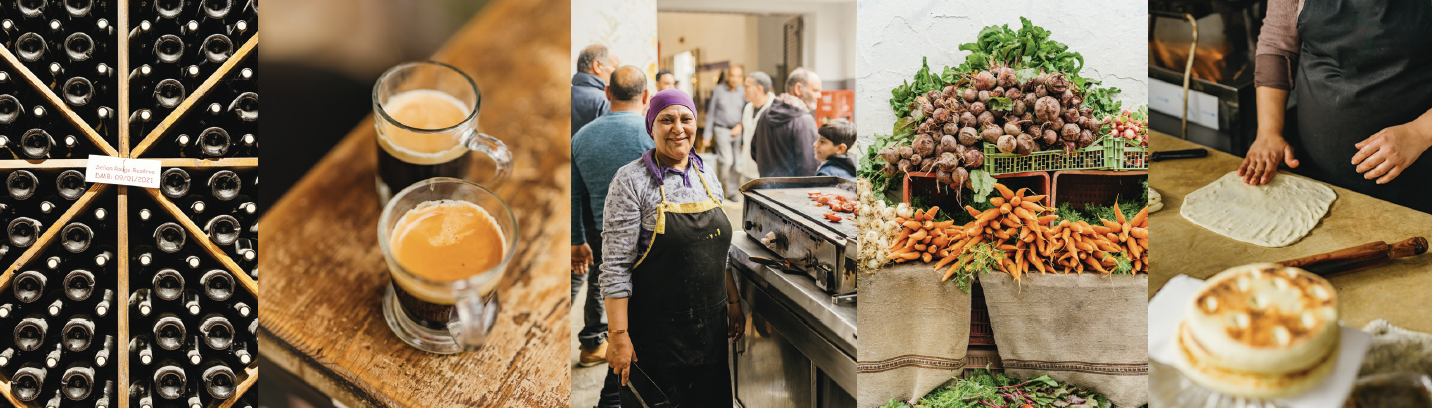
And these dishes aren’t just wheeled out for visitors, although there’s no doubt that locals are eager to share their culinary heritage. At the central market, for example, a short interaction with beloved local Chahida Boufaied at her extremely popular stall leads to a plate of freshly made slata mechouia (prepared using homegrown vegetables), which she serves with thick tabouna bread still hot from the oven.
Complimenting the flavours of the harissa at Bon Kif results in a repurposed jam jar, stuffed to the brim with the vibrant red paste, being thrust into our hands. And we also leave our visit to the Tuniso-Suisse farm with a gift of fresh lemons, an orange that is ‘incomparable to an orange from any other country’ and sheets of warm mlawi flatbread wrapped up for later to be enjoyed with – what else? – some proper harissa.
Food and Travel travelled to Tunisia’s Cap Bon peninsula courtesy of Discover Tunisia. discovertunisia.com
This article first appeared in the October 2025 issue of Food and Travel Magazine. To subscribe, click here.
Where to stay
Dar El Gaïed You’d be forgiven for walking right by this hotel in the heart of Nabeul’s medina. Entirely unmarked, apart from decorative patterns on its arched yellow doors, this boutique hideaway is set back from the street and provides a peaceful respite in a bustling part of town. Enjoying a breakfast of homemade ftira (fried dough), bsisa (a heavy mixture of roasted grains, legumes and spices) and mlawi flatbread in its palm-lined courtyard, accompanied by the faint sounds of birdsong and trickling water, it’s hard to believe you’re not in some kind of country estate. Ornate tiling on the walls and floor, plush furnishings and grand colonnades nod to the building’s former life as the residence of El Gaïed (the governor), a title held by the current owner’s grandfather during Tunisia’s short-lived kingdom in the 1950s. Doubles from £99, including breakfast. 4 Avenue Kheireddine, Nabeul, +216 53 551125, dar-elgaied.com
Dar R’Bat You’ll come across many dars in Tunisia: traditional houses converted into boutique hotels or guesthouses. This one, near Nabeul’s medina, was born from two familial homes, the oldest of which was built in 1890. French owner Valérie Domergue – who fell in love with Tunisia over a decade ago – has worked with local artisans to painstakingly restore each room, incorporating details such as upcycled original furniture and handpainted kitchen where guests staying in the four rooms can interact over traditional food prepared by housekeeper and cook Ahlem Gannar. Doubles from £71, including breakfast. 20 Rue Ibn Charaf, Nabeul, +216 28 310610, darrbat.com
La Badira An upscale adults-only stay in Hammamet, a resort town about 20 minutes’ drive south from Nabeul centre. The only member of the Leading Hotels of the World in the country, it sets itself apart through impeccable service, ogle-worthy sea views and nuanced design. Monochrome decor evokes light and shade, the very thing that made Hammamet a destination for artists and writers including Paul Klee, Oscar Wilde and Jean Cocteau. Dinner at Adra (one of three on-site dining options) is a must for its high-end Tunisian fare – don’t miss the slow-cooked lamb from Sidi Bouzid, with a sweet side of semolina, dried fruits and nuts. Doubles from £126, including breakfast. Route Touristique Nord BP437 Hammamet, +216 70 018180, labadira.com
Villa Maamoura This stables-turned-guesthouse in the rural heart of Cap Bon was once the home of Tunisian artist Faouzi El Kamel (father of current co-owner Jamila), and colour and art pervade the boho-style property in its setting of cacti and palms. Stick around for dinner, when vegetarian versions of Tunisian classics are served at a communal table on the terrace. Open March- November. From £65pp, including breakfast (two-nights minimum). Les terres de Sidi Jobrane, Maamoura, +216 23 186806, villamaamoura.squarespace.com
Travel Information
The official language of Tunisia is Arabic, although French is widely spoken as a second language. The main airport in the capital, Tunis, is Tunis-Carthage, with a flight time from London of approx. 2 hours 45 minutes. From there, the best option is to hire a car so you can explore the Cap Bon peninsula as well as Nabeul, although taxis can be an affordable option. The currency is the Tunisian Dinar (TND) and time is one hour ahead of the UK between October and March. The rest of the year it’s the same.
GETTING THERE
Tunisair fly direct from London Gatwick and London Heathrow to Tunis-Carthage several times a week. tunisair.com
Nouvelair also offer direct flights from London Gatwick. nouvelair.com
RESOURCES
Discover Tunisia is the official tourism board, providing information on important sites, heritage routes and events. discovertunisia.com
La Route Culinaire de Tunisie allows visitors to discover the food and drink of each region, with ways to experience them. larouteculinairedetunisie.info
Where to eat
Bon Kif Named after a local expression that loosely means ‘to have fun with good friends and good food’, this is a place where you immediately feel at home. It makes sense, given that the restaurant has occupied the owner’s childhood home since it opened in 1990. Blending European influences with local specialities, there’s a heavy focus on fish, all of which is wildcaught. For a meat option, get the ojja stew with merguez homemade on site using traditional methods and spices. Eat in the courtyard out back and you’ll be surrounded by greenery, fountains and Nabeulian ceramics. From £6.40. 23 Avenue Marbella, Nabeul, +216 72 222783
Dar Mrad Open since 1996, this local favourite is tucked away down a narrow, residential side street, but it’s well worth the diversion. The menu is centred on traditional dishes and fresh, local ingredients, with the menu changing each day depending on what owner Moaz Mrad finds at themorning market. If available, try Tunisian-Jewish dish madfouna – meatballs in a spinach or chard ragù – or whiting and prawn fishcakes (kefta merlan et crevettes). The house speciality is zemni Dar Mrad: stuffed green pepper, a potato rosti and kefta on a plate of rich, tomato sauce. From £4.60. Avenue Mongi Slim, Rue Khmaies el Hajri, Nabeul, +216 20 859220
El Mansourah Throughout summer, people flock from all over to dine at family-run El Mansourah, drawn by its spectacular setting. Inside the main building and adjacent bistro-bar, you’re treated to sweeping sea views, but the best seats are outside: tables are perched on makeshift terraces and craggy rocks across different levels – you may even be eating with your feet in the Med. This is not about style over substance, though. Much thought has gone into dishes including octopus tartare topped with lemon ‘caviar’ and salmon mousse on crunchy toast. Ingredients are seasonal and local – the oysters are plucked from a submerged cage outside to keep them fresh until the moment they’re served. Prices are a little higher by local standards, but worth it for such a memorable meal. From £21.60. Rue Petit Paris, El Mansourah Plage, Kelibia, +216 72 295169
Le Barberousse A beloved local restaurant on the top of Hammamet’s fort reliably serving the same selection of Mediterranean-inspired dishes – mainly seafood – for decades. Order the octopus salad, any of the seafood spaghetti options and the salt-baked fish of the day, ceremoniously carved out at your table. The restaurant has branched out with two more recent openings of the same name in Yasmine Hammamet, but the original remains the best. It’s almost always busy, not least because of its sea views, so be sure to book. From £8.60. Ville Arabe Hammamet, Hammamet, +216 72 280037
Origin Bakery Stop by this sleek café, next door to Bon Kif restaurant, for contemporary breakfast and snack options. The counter is filled with tempting treats: doughnuts glistening with chocolate icing, plump cinnamon buns and huge croissant rolls bursting with decadent fillings. It’s not just traditional tea and coffee here – the menu includes matcha, iced lattes and even boba. From £2.50 for coffee and a sweet snack. 25b Rue de Marbella, Nabeul
Restaurant Le Colibri It may have been open for only two years, but this Mediterranean restaurant has made a name for itself as one of Kelibia’s best. Run by an enthusiastic husband and wife duo who wanted to create a place they’d like to come to themselves, everything is done with extra flair. The decor is plush and colourful, food presentation can be elaborate, and extras such as mint tea and soup are often offered free of charge. Seafood lovers will enjoy the corbeille fruits de mer le colibri, an impressive platter of mussels, squid and grilled fish, with a tower of prawns and tentacles at its centre. Those in search of meat should opt for kolla la colibri, a mix of meat, vegetables and spices slow- cooked in a jarra clay pot. It’s open all year, with seats spilling out on to the atmospheric terrace during summer. From £4.60. R4P6+JHC, Avenue de Martyrs, Kelibia, +216 58 121352
Toro Fish No glitz and glamour at this roadside caff, just proper good, simple fare. Order seafood and you’ll be taken to the fishmongers next door to choose – everything you see is fresh that day, caught in the wee hours by Toro Fish’s owner himself. Your pick is then grilled next door and served with your choice of two garnishes. From £3.80. Avenue de Martyrs, Kelibia, +216 28 777536
Food Glossary
- Brik
- Thin, triangular pastry usually stuffed with tuna, harissa, onions, herbs and an egg, then fried
- Bsisa
- Thick mixture of roasted grains, legumes and spices, eaten on its own or with dates, or added to milk to form a drink. It is often consumed for breakfast to provide energy for the day
- Ftira
- Flat, round fried bread, also commonly served for breakfast
- Lablabi
- Comfort food in the form of a warm chickpea stew flavoured with garlic and harissa powder and served with chunky bread
- Merguez
- Spicy lamb or beef sausages, seasoned with harissa, cumin and coriander
- Mlawi
- Deliciously flaky semolina flatbread, cooked on a griddle and served plain or wrapped around cheese or egg
- Nouasser
- Square semolina pasta, steamed in a similar way to couscous and often combined with meat or vegetables in a spicy broth
- Ojja
- Similar to shakshuka (see below) but without the onions, this is a spicy tomato, pepper and harissa stew with poached eggs and a choice of seafood or merguez sausages
- Shakshuka
- Poached eggs in a spicy tomato, pepper and harissa sauce, usually flavoured with garlic and onions. Additional ingredients such as figs are added, depending on the season or area of Tunisia
- Slata mechouia
- Smoky salad of grilled hot peppers, tomatoes, garlic and onions, usually topped with tuna, eggs and olive oil. It’s a Tunisian staple, especially during the warmer months
- Tabouna
- Traditional round bread that is baked in a clay oven, which gives the bread its name. Thick and crusty on the outside and soft and flaky on the inside, it’s particularly good eaten alongside shakshuka or harissa, tuna and olive oil
Get Premium access to all the latest content online
Subscribe and view full print editions online... Subscribe