
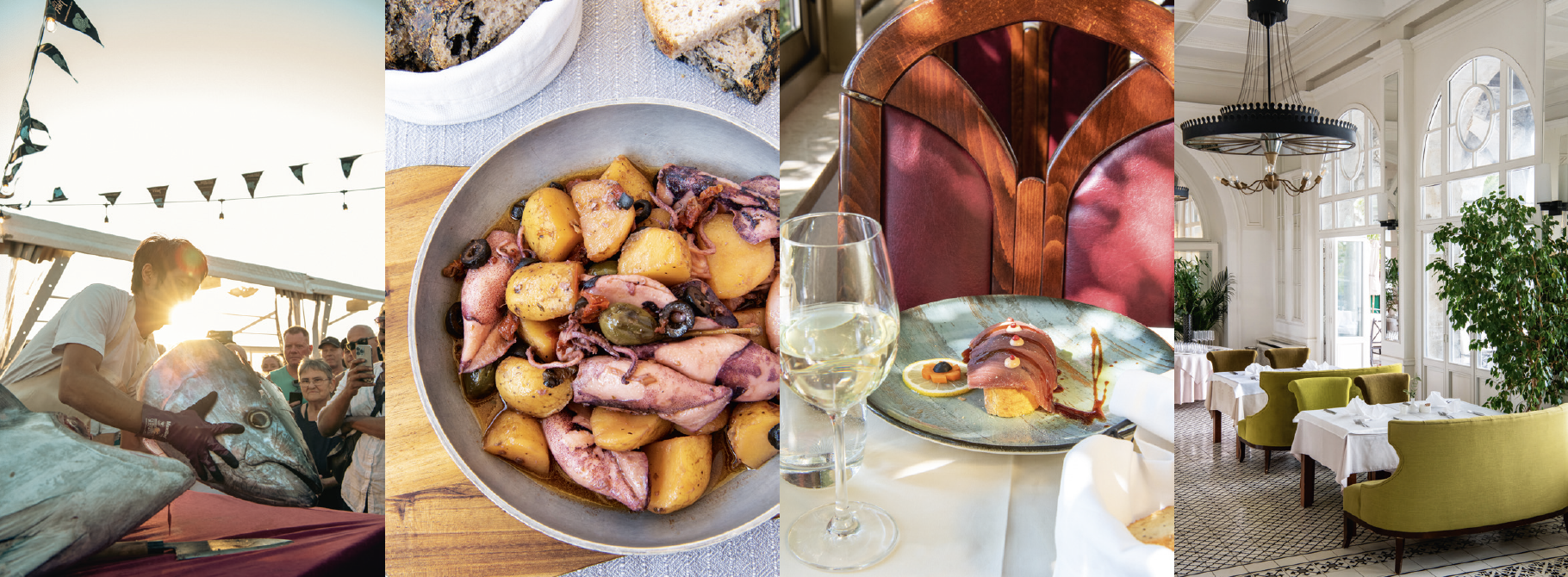
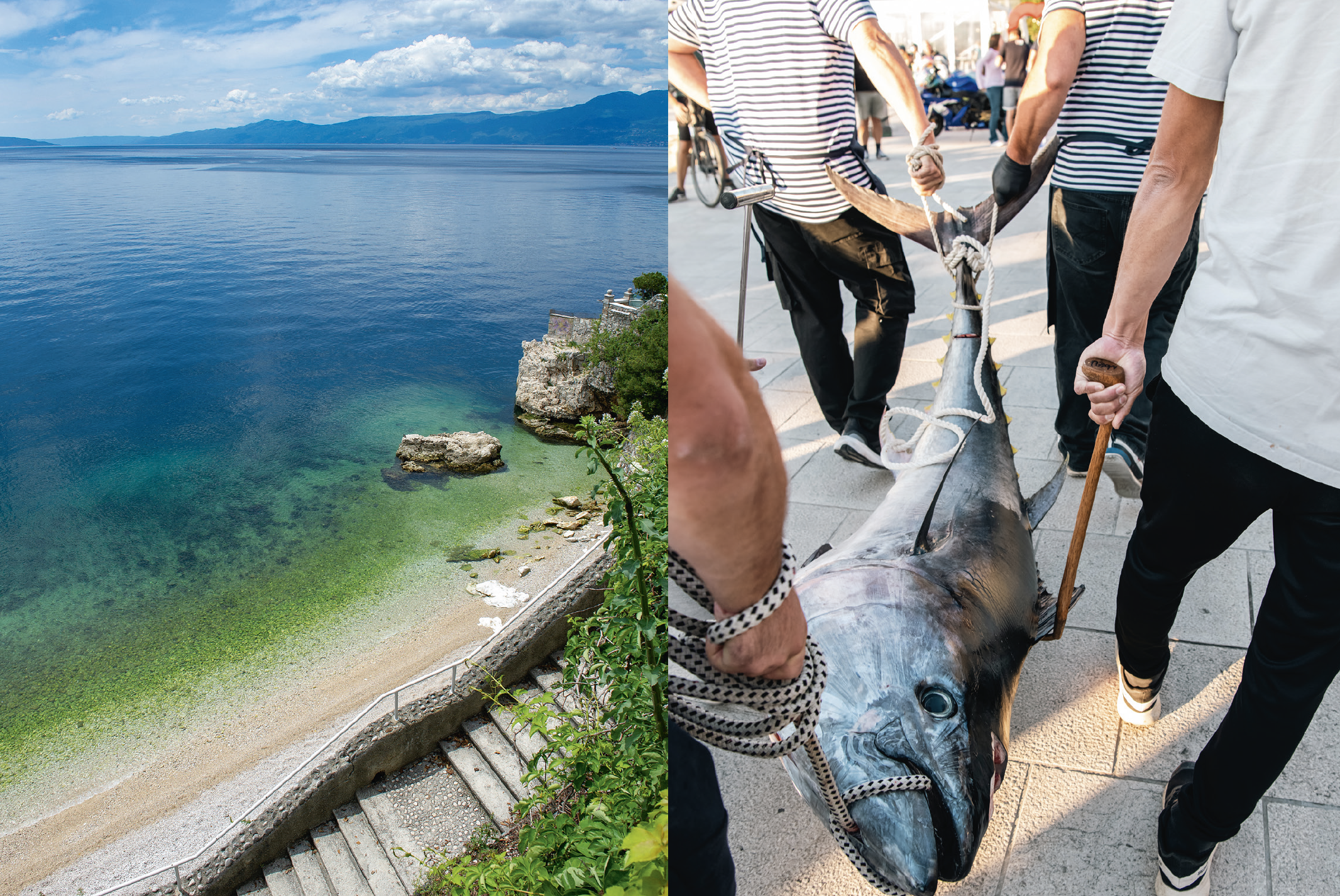
Look! That is a biiig fish!’ exclaims a little boy, his eyes glued to the white boat that has just pulled into the port. ‘That’s a bluefin tuna,’ explains the man next to him. ‘And it’s definitely a large one.’
It takes four men to lift the 110kg giant from the boat to the quay. After having carefully tied it by its mouth and huge tail fin, they carry it to Stjepan Radić Square on Crikvenica’s sun-drenched waterfront. There, sushi master Nobuhito Okada is gearing up with his remarkable set of knives, ready to artfully process it and turn it into gastronomic delicacies in front of a wide-eyed crowd.
Behind the stalls, some of the area’s most renowned chefs, wearing striped t-shirts for the occasion, dish out generous portions of local specialities – mackerel brudet stew, breaded anchovies, fried sprats, sardine fillets. Live music is played; wine is uncorked. A celebration of life’s simple pleasures that has the juicy taste of slow-simmered tuna pašticada and soft polenta.
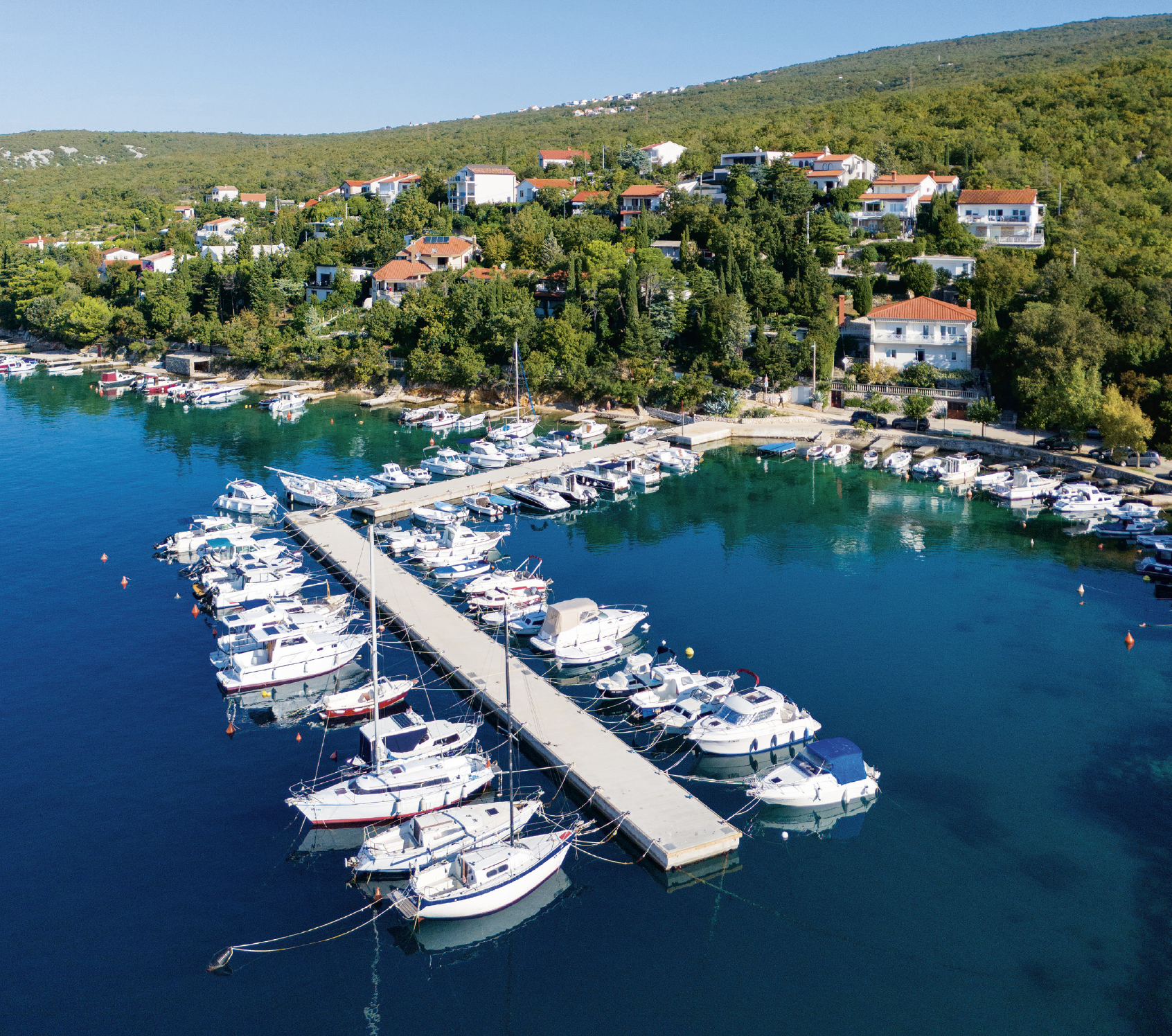
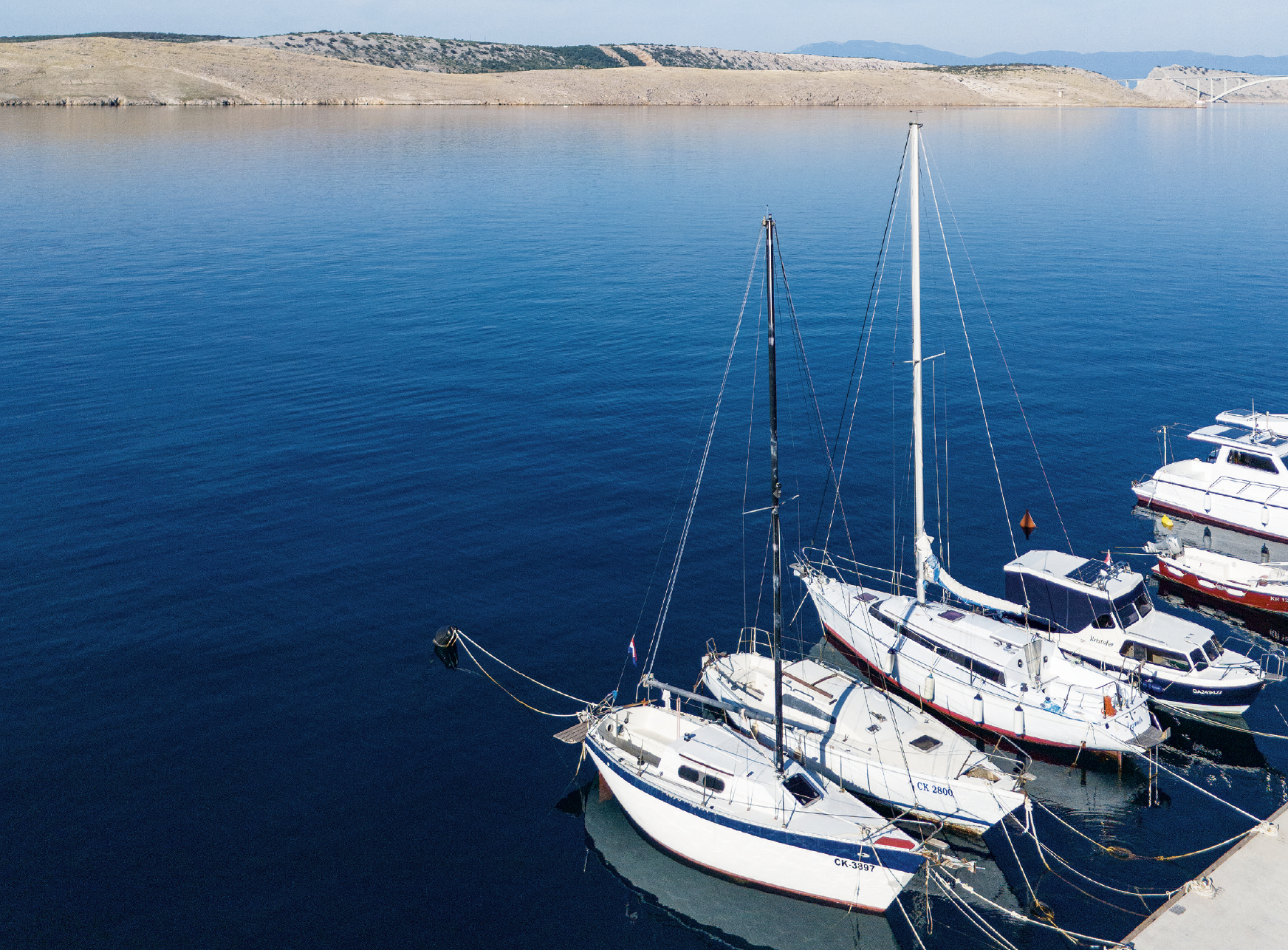
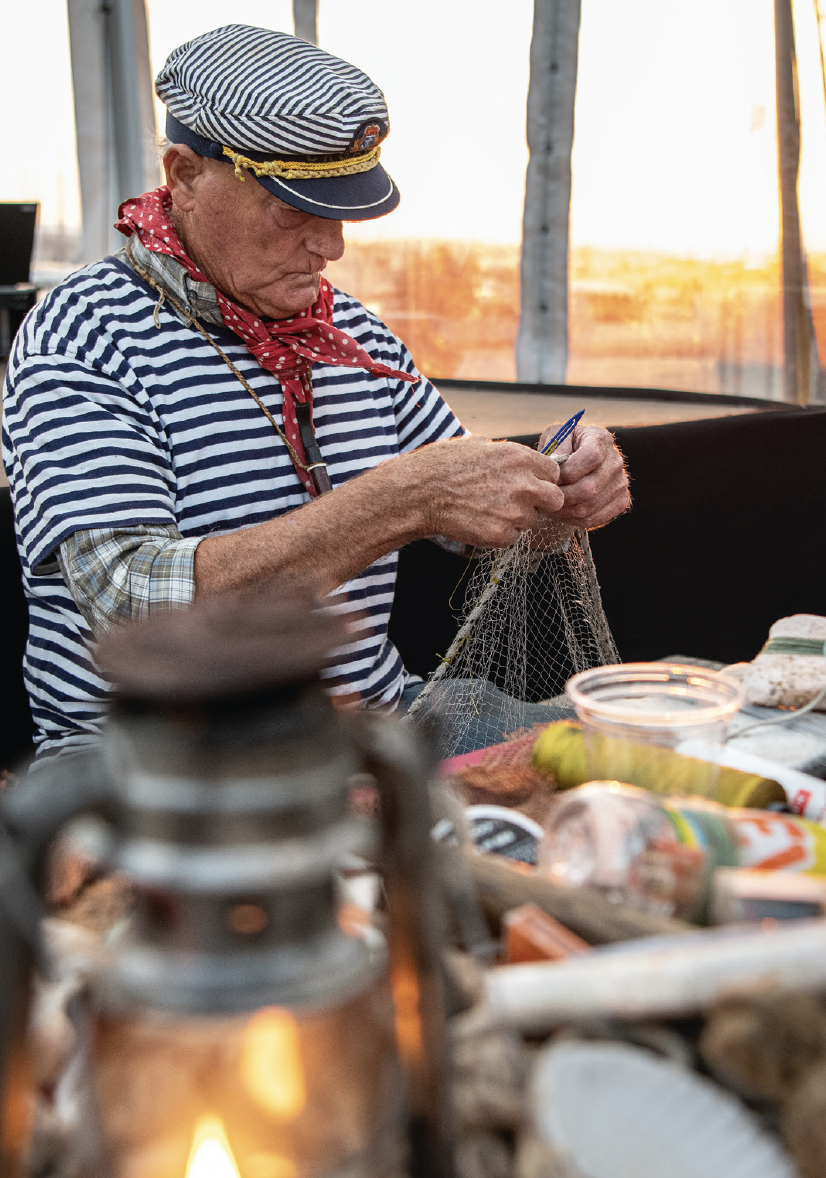
Such is the start to the Mjesec Plave Ribe (Oily Fish Month), a month-long tribute to times when nutritious oily fish were a staple of every meal and fishing was the most important activity along the Crikvenica Riviera, one of the most scenic parts of Kvarner Bay. It’s not just about a one-off event, though. The Cesta Plave Ribe, literally the ‘Bluefish Route’, brings together restaurants where fish dishes are served at quayside tables all year round, from Jadranovo to Selce. Although fishing is no longer the main focus of these villages – the area’s attraction to visitors who come for the stunning bays and crystal-clear waters contribute far more to the economy – today’s chefs have roots that go deep in the water. They are the sons and the grandsons of fishermen and still draw their inspiration from them. Renowned chef Stiven Vunić is the son of one of the oldest shrimpers in Kvarner. ‘He spent his entire working life on a boat catching shrimps and crabs,’ says Stiven. ‘His work had a huge impact on me, as a chef and as a person. His love for his job awakened in me a profound desire for local food.
‘This cuisine brings back childhood memories for me,’ he continues, surveying the stalls at the fish festival in Crikvenica. ‘It’s what you’d call comfort food. My grandmother cooked fantastic fish dishes – she was the inspiration behind some of my first fish recipes. Later on, I changed and improved them, but the base remained the same. Kvarner fish is enough on its own. For me, the saltiness of the sea and a drop of good olive oil are all it needs.’
His signature dish, a delicious fish and crab stew served at his Konoba Zijavica restaurant in Mošćenička Draga, on the other side of Kvarner Bay, is called ‘What the sea gives you’. More than a recipe, it is a manifesto. ‘From day one, we cook exclusively what the weather has to offer on that day. That is what our seasonal menu is all about – it’s completely adapted to the weather conditions at the time,’ he says. Tomislav Car, executive chef at Crikvenica’s Boutique Hotel Esplanade, has a similar story. ‘My great-grandfather was a fisherman and my entire life’s been connected to our local fish,’ he explains as plates of risotto with peas and tuna confit are served on the restaurant’s sea-facing terrace. ‘I prefer oily varieties to white fish,’ he continues. ‘Handled correctly and eaten fresh, they are among the sweetest, most delicious types of fish around.’
Kvarner Bay, nestled between the Istrian peninsula to the west and Dalmatia in the south, has been a prime tourist destination since the 19th century, thanks to its mild climate. Elegant Opatija – nicknamed ‘Vienna on the sea’ for its belle époque architecture – was once a favourite with the Austro-Hungarian elite. The tradition continues today, with the area being a favourite destination for wellness and active holidays – and food.
‘One step away from the sea, two steps away from snow,’ they say here. Tucked between the mountains and the island-dotted sea, Kvarner sits at the intersection of different climates – Mediterranean, continental and mountainous – as well as diverse culinary traditions. This is where the earthy food of no-frills konobas (taverns) meets the aristocratic cuisine of the Frankopan family, closely connected with Croatian history for around six centuries and as decadent as a slice of Frankopan torta, an overindulgent feast of a cake containing whipped cream, almonds, rose water, raisins, cinnamon and nutmeg, sublimely topped by a peach compote. If baroque was a food, this would be it.
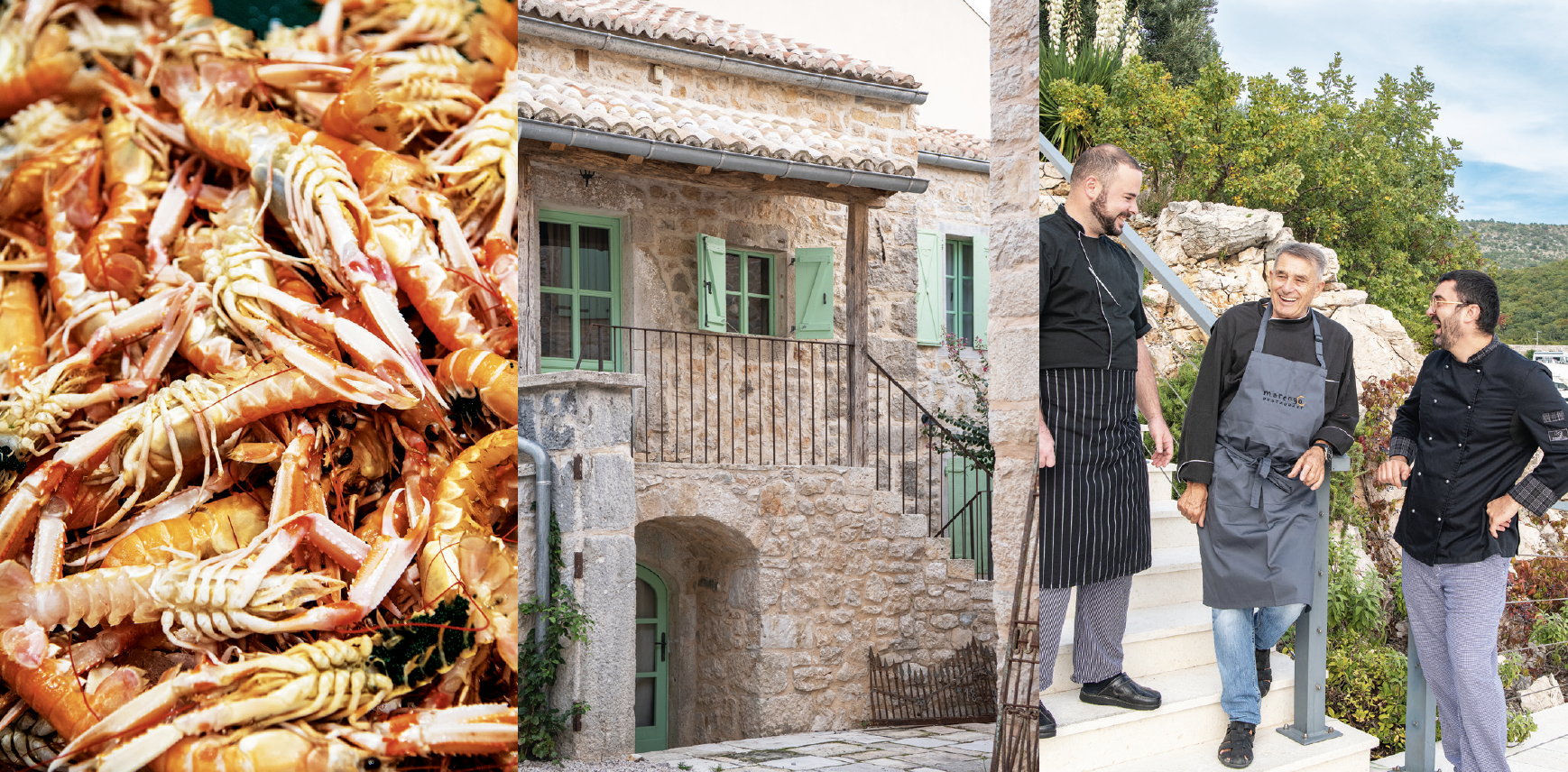
Driving towards the mountains, the view opens up to the whole Croatian littoral, with its countless islands, and sums up the local cuisine: olive groves and vineyards, as well as chestnut, cherry and fig trees, hug the coast. Behind them are fields of vegetables – with broskva, a type of winter cabbage, being a big favourite. Further up, in the hinterland of Novi Vinodolski, come the sheep pastures and the grazing grounds for wild horses. Herbs are everywhere: thyme, rosemary, sage, laurel, heather, along with wild garlic sprouts and wild asparagus. Remarkably, all of this circles back to the sea. Mountain streams bring leaves and organic material down to the Adriatic and they deposit as the ‘blue mud’ that provides an excellent habitat for the soft pink Velebit Channel langoustines.
‘They are the best in the world,’ proudly exclaims local guide Vjeročka Lončarić, standing on the Kuk belvedere and pointing in the direction of the Velebit Channel, between the eponymous mountain and the barren rocky slopes of the island of Krk on the other side. ‘The water is brackish because of the fresh water coming down from the mountain. It is also very cold, so langoustines love it. They have a unique sweetness, a tenderness and elegance in taste that can’t be compared,’ she says.
The best ones are caught with vrša fish traps – fishing equipment made from brushwood or wire netting with one or two holes through which fish can enter the trap – as this does not damage the seabed or the langoustine itself. ‘The largest ones are just briefly grilled,’ Vjeročka continues. ‘The middle-sized ones are delicious in a buzara-style stew, a thick soup with lots of garlic, parsley and tomato and a few breadcrumbs to thicken it.’
The Adriatic is home to around 400 varieties of fish, which are caught sustainably, according to the ‘quality over quantity’ credo. A visit to the art nouveau Mrkat fish market in the heart of Rijeka – Croatia’s largest port – provides a glimpse into this remarkable wealth, about 40 minutes’ drive to the west of Crikvenica. It’s a temple-like, two-tiered market hall, so grand it could double as a ballroom (and on certain occasions throughout the year, lighting and music do transform it into a party venue). Venetian sculptor Urbano Bottasso finely decorated it with a vast marine world consisting of stone crabs, seashells, fish and octopuses, reflecting what is being sold here. The stalls made of grey Istrian stone are brimming with sardines, silver-bellied anchovies, small mackerel, black tiger shrimps, the ubiquitous tuna, swordfish, exquisite scallops, dark grey morska mačka (catfish) sold skinned, and huge-mouthed grdobina, aka monkfish (grdo translates as ‘ugly’). There’s everything from inexpensive and frequent cipal (grey mullet) to intensely flavoured oysters and Velebit scampi.
As per an old local saying, ‘fish has to swim three times: the first in the sea, the second in olive oil and the third in wine,’ it comes as no surprise that this region has been home to grape cultivation for more than 2,000 years. The Romans were the first to recognise its potential; the first written mention of wine barrels on Krk is in a poem by Marcus Annaeus Lucanus dating back to the 1st century.
Behind Novi Vinodolski, the southernmost town of the Crikvenica Riviera, lie the rolling hills of the Vinodol Valley, a prime wine region whose name is a literal translation of the Latin Vallis Vineari: the Valley of Vineyards. ‘What you see here was blanketed in vineyards until the end of the 19th century; then phylloxera destroyed everything,’ explains winemaker Miroslav Palinkaš over a glass of his Classic Method and a plate of local cow’s cheese and wood-smoked Dalmatian pršut (ham) in the garden of his Pavlomir estate. After WWII, tourism boomed and nobody was interested in working the land any more. Vineyards disappeared; viticulture was neglected.’
Together with Andrija Biro, Miroslav is the man behind the renaissance of winemaking in Vinodol. A winegrower by profession, he was originally from Šarengrad, on the banks of the Danube, close to the Serbian border. There, his family still owns four hectares of white graševina. He arrived in Vinodol in 1994, during the Balkan War.
‘We received the land from the local authorities as refugees. There was only a ruin there,’ he recalls, pointing to where the wine cellar now stands. ‘We rolled up our sleeves and started all over again.’ His rebirth coincided with that of the estate.
Today, Pavlomir counts 40 hectares, of which 31 are vineyards. Besides well-known varieties such as cabernet sauvignon and chardonnay, they pay special attention to žlahtina, an autochthonous grape grown almost exclusively on the island of Krk. This strawhued wine encapsulates the essence of the Mediterranean, delivering floral and citrus fragrances, herbal notes – especially sage – and a refined touch of saltiness with each sip.
When in Kvarner, it is not unusual to come across a wine you’ve never heard of, as the production relies largely on indigenous grape types. ‘As many as 85 per cent of our grapes are autochthonous,’ explains Žarko Stilin, director of the Kvarner Wines association, which groups ten wineries from the territory. ‘The dominant variety, žlahtina – “the queen of Kvarnar” – accounts for 95 per cent of the entire production. Sansigot ranks as the second most significant grape, a fresh variety from the small island of Susak, produced by two or three wineries only. Overall, we have 36 distinct grape varieties and 40 labels, which encompass a range of wines from sparkling to sweet and amphorae-aged, for a total of one million bottles per year.
‘The peculiarity of our wines is that you can buy them only here,’ Žarko continues. ‘If you want to drink them, you have to come and spend a few days in the region. But then it makes sense because the wines are a perfect match for our seafood,’ he exclaims, pouring a generous glass of red sansigot. Its acidity does indeed pair very nicely with the grilled tuna steak on the plate. In an increasingly globalised food landscape, opting not to export wine and instead inviting people to visit its place of origin to sample it there is a compelling and refreshing approach.
Food and Travel travelled courtesy of Croatia Full of Life croatia.hr
This article first appeared in the August/September 2025 issue of Food and Travel Magazine. To subscribe, click here.
Where to stay
Balatura Hotel Village Anne-Kathrin and Gordan Godec are the creative minds behind this idyllic countryside getaway in the heart of the Vinodol Valley. The husband-and-wife duo transformed Gordan’s grandfather’s estate into a welcoming retreat, which opened its doors in 2008 after a two-year restoration. It comprises 17 rooms and two apartments scattered amid a lush garden with a one-of-a-kind pool secluded by stone walls. Festivals, concerts, events and yoga retreats are held here regularly, making it a hotspot for artists and creatives. The in-house vegetarian and vegan restaurant offers a daily changing three-course meal and is open to non-guests too (booking essential). Open April to October. Doubles from £138, including breakfast. Mali Sušik 2, Tribalj, +385 51 455340, hotel-balatura.hr
Boutique and Design Hotel Navis Nestled in the secluded Preluk Bay between Opatija and Rijeka, five-star, family-run Navis is set into the steep cliffs overlooking the sea where an old disco once stood. Idis Turato, Croatia’s most renowned architect, is responsible for its stylish transformation. It has 44 rooms and suites featuring tailor-made furnishing by Croatian luxury design company Prostoria and floor-toceiling sliding glass windows opening on to balconies overlooking the Adriatic. The impressive list of facilities includes a spa, an outdoor heated pool, a private beach, a boat pier and a fine-dining restaurant. The latter is an experience in itself, with lobster, fresh oysters and Istrian truffles being the highlights of its à la carte menu. The extensive wine list counts over 200 between Croatian and international wines. Doubles from £267. Ivana Matetića Ronjgova 10, Opatija, +385 51 444600, hotel-navis.hr
Boutique Hotel Esplanade On Crikvenica’s seafront promenade, a short walk away from the town centre, the 38-key Esplanade is made up of two separate buildings, the older one dating to 1929 and the newer,larger one renovated in 2017. Most rooms have a sea view – the corner ones come with balconies and impressive four-poster beds. Doubles from £148, including breakfast. Strossmayerovo šetalište 52, Crikvenica, +385 51 785006, jadran-crikvenica.hr
Hotel Bellevue It’s all about the Austro-Hungarian atmosphere of the 19th-century Riviera at this historic hotel right in the centre of Opatija. All 87 rooms overlook the city’s elegant coastal promenade, the Lungomare. Among the facilities: a wellness and spa centre and an indoor pool with heated seawater. Doubles from £124, including breakfast. Maršala Tita 144/148, Opatija, +385 51 710444, liburnia.hr
Travel Information
Kvarner Bay, or the Kvarner Gulf, is a bay in the northern Adriatic Sea, nestled between the Istrian peninsula to the west and Dalmatia to the south. It sits at the intersection of three different climates (Mediterranean, continental and mountainous), allowing you to jump from the sea to the mountains of Gorski Kotar. Summer is dotted with events dedicated to seafood, including Fisherman’s Week. The next one is scheduled for 30 Aug-6 Sept; the next Oily Fish Month will take place from 19 Sept-19 Oct across the coastal towns of Crikvenica, Dramalj, Jadranovo and Selce. Theofficial language is Croatian, although English is widely used. Currency is the Euro and time is one hour ahead of GMT.
GETTING THERE
Ryanair flies direct to Rijeka airport, Krk, from London Stansted twice a week from June to September. ryanair.com British Airways flies to other airports in the region, such as Pula and Zagreb, and passenger ferries operate between the islands, making it easy to combine a stay with other Croatian destinations. britishairways.com jadrolinija.hr
RESOURCES
Croatia Full of Life is the official website of the Croatian National Tourist Board, packed with information about the country. croatia.hr
Riviera Crikvenica is dedicated to the eponymous coastline and is full of helpful tips to help you plan your journey. For on-site assistance, visit their office located in the centre of Crikvenica. rivieracrikvenica.com
Where to eat
Prices are per person for two courses, excluding drinks, unless stated
Domino Simple, traditional and seasonal: chef Dragan Visković has clear ideas about the food he wants to serve in his no-frills eatery in the fishing village of Dramalj. Local seafood offerings include Adriatic squid, bluefin tuna and calamari. From £30. Braće Car 23, Dramalj, +385 51 786472, domino-dramalj.com
Hotel Miramare The restaurant of this high-end hotel, right on Crikvenica’s seafront, is committed to serving excellent Mediterranean cuisine with the finest seasonal and local ingredients. From £39. Ulica bana Josipa Jelačića 2, Crikvenica, +385 51 707100, miramare.hr
Konoba Na Kantunu This quaint tavern on the bank of the Mrtvi Kanal has been serving some of the best seafood in Rijeka for nearly three decades. The refrigerated display at the entrance brims with the catch of the day from langoustine and scorpion fish to John Dory and seabass – you name it – to be grilled to perfection. Or try traditional Dalmatinska pašticada beef stew in a creamy sauce accompanied by parsnip purée. From £24. Wenzelova ul. 4, Rijeka, +385 51 313271
Konoba Zijavica Right on picturesque Mošćenička Draga’s long pebble beach, chef Stiven Vunić presents a culinary experience where the daily catch shines, whether through delicate raw fish dishes or traditional recipes served straight from the pot. Excellent desserts too. Tasting menus plus à la carte. Six-course tasting menu £68. Šetalište 25, travnja 2, Mošćenička Draga, +385 51 737 243, konoba-zijavica.com
Lemoon The restaurant of the Boutique Hotel Esplanade offers charming ambiance and tasty local fare. Start with marinated anchovies, served with a fresh emulsion of Mediterranean citrus fruit; continue with chef Tomislav Car’s green pea risotto with Adriatic tuna confit;, and make some room for a slice of Frankopan cake. From £22. Strossmayerovo šetalište 52, Crikvenica, +385 51 785 006, jadran-crikvenica.hr
Marengo The floor-to-ceiling windows and outdoor tables of this sleek modern restaurant offer unbeatable views of the glamorous Mitan Marina in the southern part of Novi Vinodolski. Choose between a four-course meat or fish tasting menu or à la carte dishes. Yachtsmen come here for its exquisite buzara made with kunjka (a type of shellfish), clams, mussels and langoustine, as well as for the fish al forno feast for two, which takes about an hour to cook – well worth the wait. Four-course tasting menu from £42. Obala dr Josipa Sokolića 1a, Novi Vinodolski, +385 51 627762, mitanmarina.com
Plavi Podrum The oldest restaurant on the Opatija Riviera focused on dailysourced ingredients from the bay. Think langoustine, Adriatic fish and Istrian white truffle and saffron. Don’t miss the branzino left in salt and herbs for hours and then wrapped in dehydrated parsley and cooked sous vide. Owner Daniela Kramarić is also one of Croatia’s best-known sommeliers – the wine list has around 250 labels. Tasting menus and à la carte. Four-course tasting menu £59. Obala Frana Supila 6, Opatija, +385 51 701 223, plavipodrum.hr
Restaurant Burin Local seafood makes up 80 per cent of the menu, with a mouthwatering selection of fish tartare and carpaccio. Opt for the risotto with scampi and Granny Smith apples or squid with dried tomatoes, caper flowers, olives and potatoes, served straight from the pan. From £38. Dr Ivana Kostrenčića 10A, Crikvenica, +385 51 785 209, restaurant-burin.eatbu.com
Rumac Family Farming Estate With vintage furniture straight out of Grandma’s living room, and owners Patricia and husband Andrijano greeting you in their traditional attire, the lovely Rumac estate near medieval Veprinac feels like stepping back in time. Food is homely and tasty, accompanied by generous amounts of their award-winning wines. Open at weekends; book at least one day in advance. Three-wine tasting with pasta and dessert. From £17. Poljane, Maćuki 1, +385 98 969 1067
Yacht Club Fish Restaurant Set in a listed building right on the water at Opatija’s marina, this superb, family-run pieds-dans-l’eau restaurant is celebrated for its authentic Istrian and coastal fare. The menu features an extensive selection of fish – whether grilled, baked or cooked in wine. Their mouthwatering sharing platter ‘A fish bites a fish’s tail’ is a must-try: expect the likes of white fish fillet, Adriatic tuna, octopus, shrimps, monkfish medallion, wild cabbage and potatoes. From £36. Zert 1, Luka Opatija (Opatija Harbour), +385 91 227 2345, yacht-club-opatija.com
Food Glossary
- Batuda
- A minestrone soup traditionally prepared in the winter months
- Broskva
- A cultivar of cabbage typical of the Croatian littoral. Best eaten in brovska na padelu: boiled with potatoes, then sautéed with olive oil or lard
- Brudet
- A flavourful seafood stew with many variations; at least three different types of fish are used - such as scorpionfish, monkfish, seabass, or other white fish - all cut into larger chunks and left on the bone
- Buzara
- A Croatian technique of preparing seafood by cooking it in a mixture of olive oil, wine, garlic, fresh herbs (usually parsley) and sometimes breadcrumbs. The resulting sauce gives the dish a distinctive, fresh, clean flavour reminiscent of the sea.
- Frankopan torta
- A traditional cake made with puff pastry, whipped cream, egg yolk, sugar, corn starch, almonds, raisins, rose water, butter, lemon zest, cinnamon and nutmeg. The first mention of this delicacy appeared in a 1686 cookbook by Duchess Eleonora Maria Rosalia von Eggenberg
- Pašticada
- Traditional Croatian beef stew; a tuna version, pašticada od tune, is typically paired with polenta, gnocchi or potatoes.
- Rupice
- Fish balls made with anchovies, flour, polenta, garlic and parsley
- Sansigot
- An indigenous red grape variety from the island of Susak
- Žlahtina
- An autochthonous grape variety grown almost exclusively on the island of Krk. The white wine that beats the same name is light and refreshing, with floral and fruity aromas complemented by mineral notes and a well-balanced acidity.
Get Premium access to all the latest content online
Subscribe and view full print editions online... Subscribe